Agile Business Process Management (Agile BPM) with Jira
In short: Agile business process management (Agile BPM) combines the focus of BPM on repeatable processes with agile principles: small iterations, close collaboration, and continuous improvement. The process model guides people instead of forcing them. Flower supports this: you model processes in BPMN, run them in Jira, check the results, and refine the model in short cycles.
Last updated: October 2026
What Is Agile Process Management?
In 2001, a group of software developers published the Agile Manifesto as a better way to develop software. It is a set of values and principles that you can apply to any project management method. Its four values are:
- Individuals and interactions over processes and tools
- Working software over comprehensive documentation
- Customer collaboration over contract negotiation
- Responding to change over following a plan
The first value seems to downgrade processes. Is agile process management a contradiction? No. The Manifesto says that there is value in the items on the right, but it values the items on the left more. People and interactions come first, and processes support them.
How Does Business Process Management Fit with Agile Principles?
Traditional BPM follows a top-down approach: management drives process improvements, and everybody follows the model. Agile is decentralized: team members work together to find and implement improvements. Agile process management combines both.
Flower follows this idea. A traditional BPM system expects all participants to follow the model strictly and escalates every deviation. The engine may even stop if somebody does not perform an activity correctly. That works for a bank transfer, but not for long-running management processes that need flexibility. The larger a process becomes, the less likely it is that every run is exactly the same.
With Flower, you can use a BPMN model in two ways: the engine can run it automatically and create the Jira work items for you, or you can use it as a guide. In the guided style, the model suggests the next activities, and the process owner decides when to start them and can change the running process. Large, long-running processes often benefit from the guided style, and highly standardized processes from automation.
An agile approach to BPM can also mean breaking large processes down into smaller sub-processes and reviewing and improving them continuously. Both agile and BPM rely on a continuous improvement cycle at their core.
The Continuous Improvement Model in Agile BPM
Continuous improvement is the never-ending effort to get better. In Japanese, it is called Kaizen. Kaizen originated in Japan after the Second World War and became one of the foundations of the rise of Toyota.
The Lean approach to business processes rests on three principles: deliver the value that the customer defines, eliminate waste, and improve continuously. In agile process management, continuous improvement strengthens the activities that create the most value for the customer and removes waste.
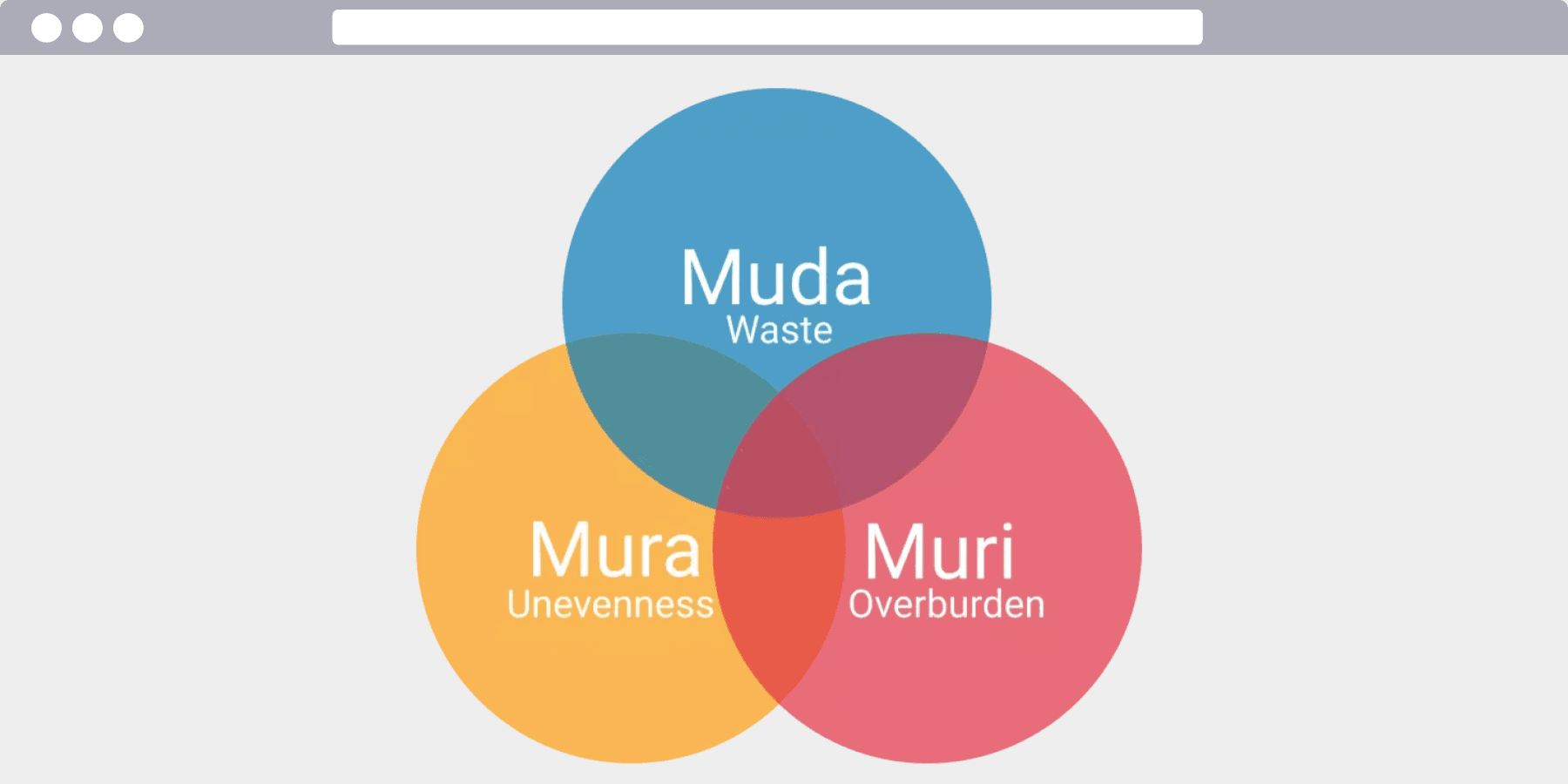
Lean distinguishes three types of waste:
| Type | Meaning |
|---|---|
| Muda | Seven wastes: transport, inventory, motion, waiting, overproduction, over-processing, and defects |
| Mura | Unevenness in the process, which blocks continuous flow and causes many of the seven wastes |
| Muri | Overburden, for example when too much work is assigned to a team |
You cannot remove all waste, but you should keep its effects small. If continuous improvement is to become part of your culture, focus on eliminating it.
How to Adopt Continuous Improvement
Lean knows three major approaches:
- Root cause analysis drills down into a problem by asking what caused it until you reach the root. A cause is the root only if removing it prevents the negative effect for good.
- A Kanban board visualizes the workflow and limits work in progress. Jira provides one out of the box.
- Plan-Do-Check-Act (PDCA) is a simple cycle that is common in traditional BPM as well as in agile. It is the best starting point for agile process management.
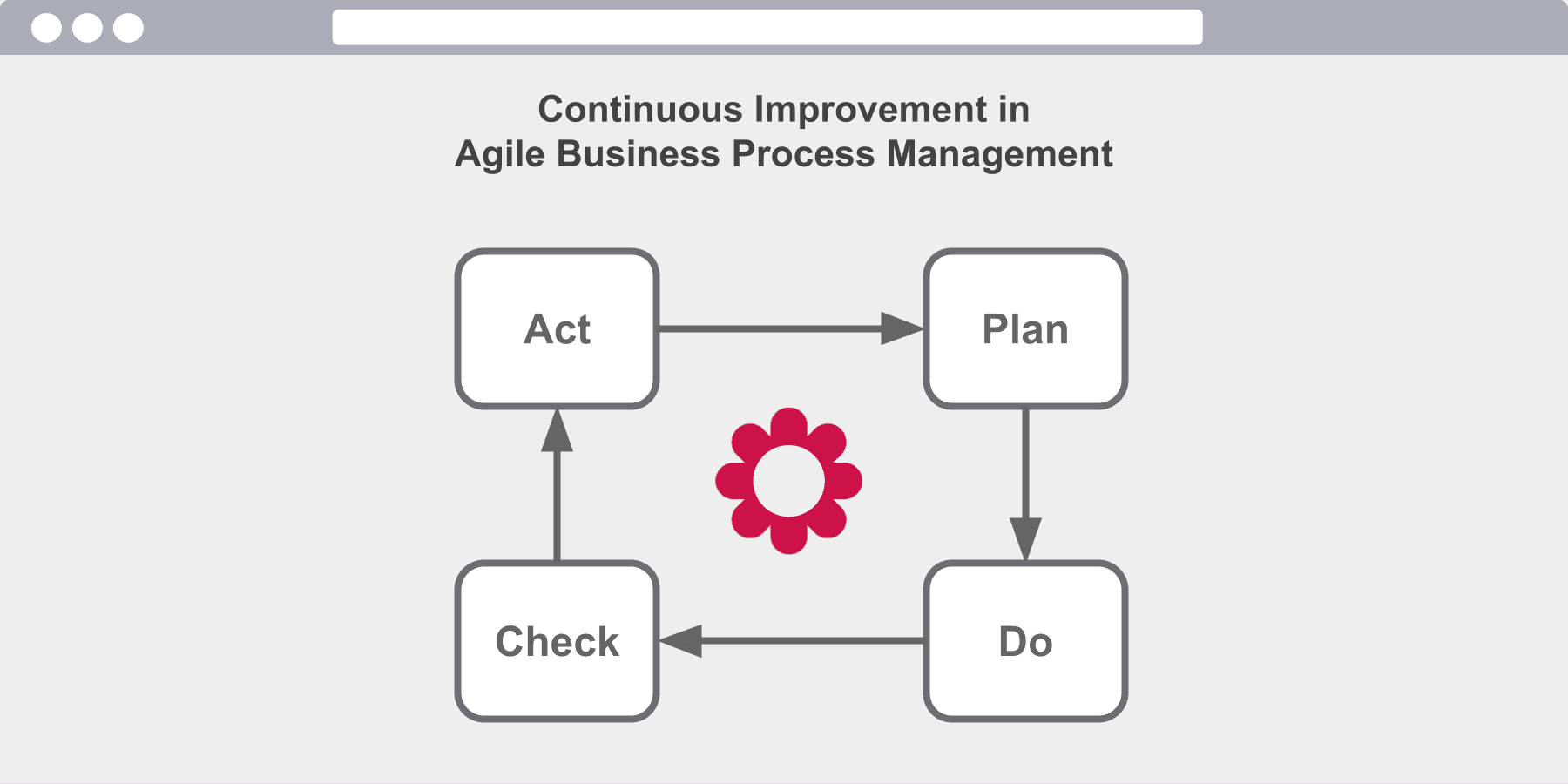
PDCA with Flower works like this:
| Phase | What you do | In Flower |
|---|---|---|
| Plan | Set objectives and describe the process | Draw the BPMN model in the graphical modeler. Learn more about BPMN |
| Do | Execute the plan | Launch an instance of the process model |
| Check | Compare the result with the expectation | Use the model report, Jira filters, and reports to collect data |
| Act | Improve the process | Adjust the process model, publish a new version, and start the next iteration |
Important: Keep adjustments to the process model lean and limited to organizational aspects. Avoid costly software customizations and API changes, because they slow down the iterations.
Principles of Continuous Process Improvement
The principles stay the same, no matter whether you apply them in agile or in BPM:
- Small changes: Improvements come from small, incremental changes. There is no need for big paradigm shifts.
- Employees matter: Employees work in the processes every day and see where inefficiencies lie. Let them identify opportunities and make their voices count.
- Incremental is inexpensive: Employees often find ways to remove steps instead of adding more, and small changes are cheaper.
- Employee ownership: People who help to design a change are more open to rolling it out. Automation helps to keep a change in place, because automated processes become standard.
- Improvement is reflective: Visibility and collaboration help people see how their actions affect the result. Dashboards and reports show changes in real time.
- Measurable and repeatable: Measure small improvements to see whether they work. For example, track the average days until payment after you automate how receivables are collected.
Agile BPM vs. Traditional BPM
Most organizations prefer the agile approach today for its efficiency and higher success rate.
| Agile BPM | Traditional BPM |
|---|---|
| Adaptive: flexible and responsive to changes during iterations | Predictive: follows a plan and is not responsive to changes until the process is completed |
| Cyclic: works in loops and allows going back to adjust | Linear: each phase is completed before the next one starts |
| Customer-centric: creates a result that meets customer needs | Process-centered: the aim is to complete the process according to the plan made at the start |
| Collaborative: the customer gives feedback and requests changes in each iteration | Contractual: requirements are fixed in a contract before work begins |
Learn how to turn a Jira space into a business process
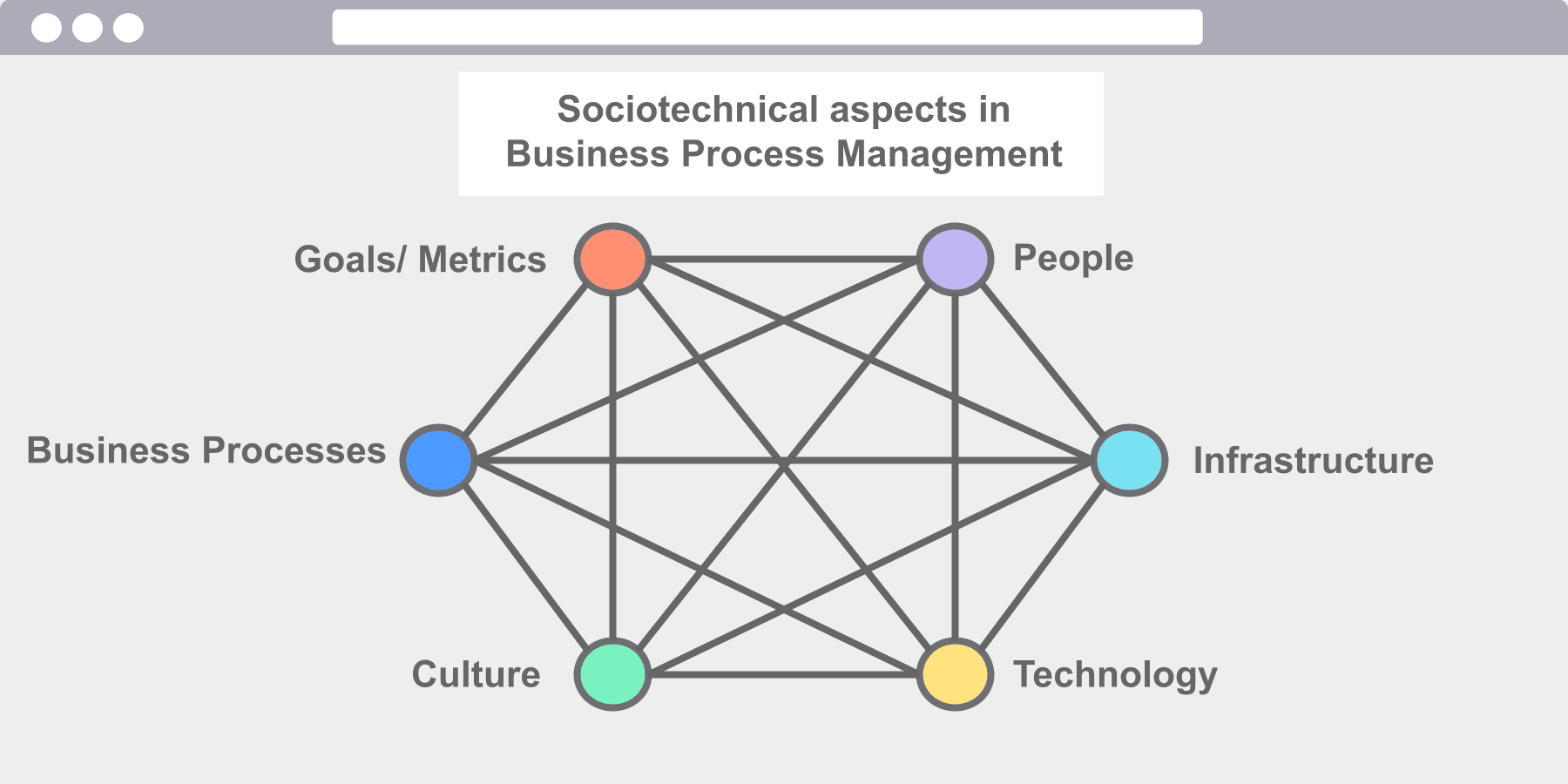
Sociotechnical Aspects of Business Process Management
The design and performance of an organizational system can only be understood and improved if its social and technical aspects are treated as interdependent parts of one complex system. Traditional BPM often fails because it looks at only one aspect, such as technology or structure.
A gas turbine engine is a good comparison: any change to the engine must consider how it affects the rest of the system, and the same is true for an organization. Nobody understands all interdependent aspects of a complex system alone. Therefore, involve the key stakeholders from all parts of the system in the understanding and the continuous improvement. This is called user participation, and it is essential for successful change.
What Is an Agile Workflow?
An agile workflow organizes work in small, incremental pieces called iterations or sprints. At the start of each iteration, the team decides which tasks deliver the most value and completes them in that iteration. This delivers working results early and brings feedback from stakeholders early.
The agile workflow lifecycle is generally the same for every project:
- Define the goals and create a high-level roadmap.
- Break the work into small pieces called user stories. Each story is a piece of functionality for the customer.
- Prioritize the stories by their importance and value.
- In each iteration, select the stories according to priority and team capacity.
- Work on the stories with frequent collaboration, testing, and documentation.
- At the end of the iteration, review and demonstrate the result, collect feedback, and adjust the plan.
Jira Software comes with built-in agile workflows, for example for Scrum and Kanban. Learn more about the difference between workflow, business process management, and project management
Common Agile Methods
- Feature-driven development develops core features in short, frequent cycles.
- Crystal is a lightweight method centered on people and their needs.
- Agile unified process is a simplified version of the rational unified process with adaptable frameworks.
- Extreme programming depends strongly on customer feedback.
- Scrum uses cross-functional teams that deliver specific functionality in repeatable sprints.
- Kanban is a non-iterative lean method that keeps work in progress and the backlog under control.
Frequently Asked Questions
What is agile BPM?
Agile BPM combines business process management with agile principles. Processes are designed and improved in short iterations, with the people who do the work.
Is agile process management a contradiction?
No. The Agile Manifesto values individuals and interactions over processes and tools, but it does not reject processes. Agile BPM uses process models as guidance and improves them continuously.
How does Flower support agile BPM?
You model a process in BPMN, run it in Jira with one work item per activity, measure the result with Jira filters and reports, and publish improved model versions. Running processes keep the version they started with.
About Flower
Flower – Business Process & Workflow Automation (BPMN) for Jira is an app on the Atlassian Marketplace for Jira Cloud and Jira Data Center. It lets you model business processes in BPMN 2.0 and run them in Jira: for every activity of a process, Flower creates a Jira work item, assigns it through swimlanes, shows its status in the process diagram, and continues the process when the work item is resolved. Flower stores all process data in Jira, so your permissions, boards, and reports keep working. Flower is Cloud Fortified and has been on the Atlassian Marketplace for more than ten years.
Start a free 30-day trial on the Atlassian Marketplace or follow the Get Started guide.