
Four Eyes, One Smile
Approvals with Flower BPM
Four Eyes, One Smile: Approvals with Flower BPM
An approval step, also known as the four-eyes principle, means that a second person has to confirm something before a process continues. Typical examples are hiring new talent, buying a new laptop, or granting access.
You can build approvals in two ways:
| Approval in Flower BPM | Approval in a Jira workflow | |
|---|---|---|
| How | An approval activity and an XOR gateway in your BPMN model | An approval step on a status of a Jira workflow |
| Who approves | The team in the approval swimlane | The approvers set on the work item |
| Available in | Every space | Service spaces. In other spaces only with Jira Premium or Enterprise. |
| Best for | Approvals that are one step of a larger process, often done by another team | Approvals that belong to the lifecycle of a single work item |
Approval with Flower BPM
Often the approval is done by another team than the work itself, so it takes place in a different swimlane.
A typical model looks like this: the work is done in one swimlane, the approval activity sits in another, and an XOR gateway follows. If the work is approved, the process continues. If it is rejected, a transition leads back to the work.
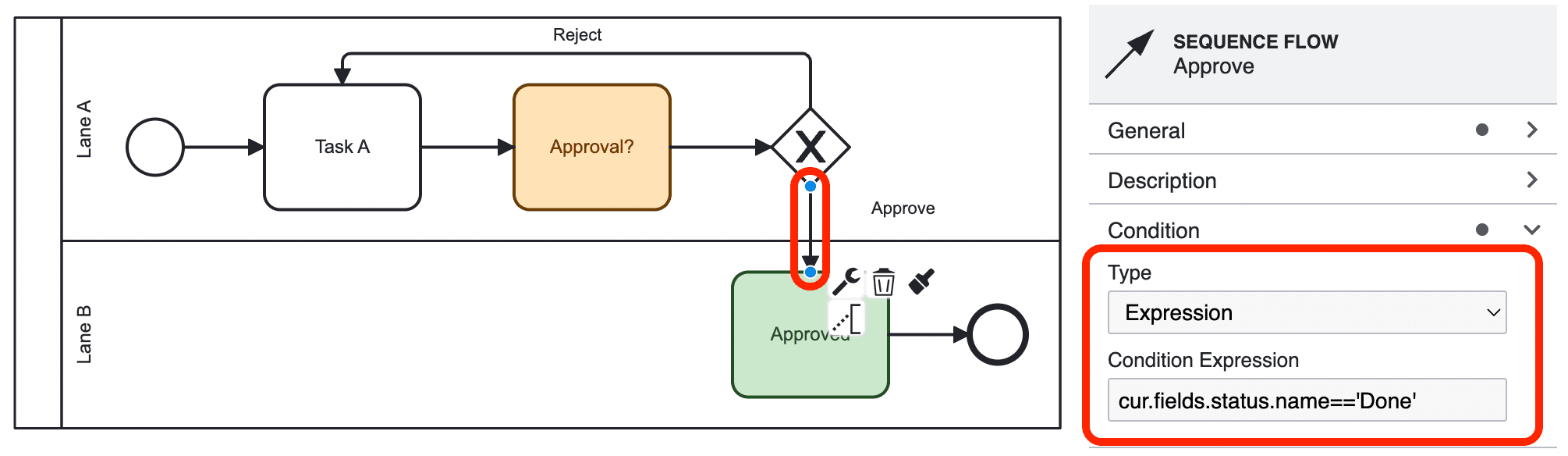
The decision works like this:
- The process waits until the work item of the approval activity is resolved.
- The XOR gateway evaluates the conditions of its outgoing transitions.
- The process follows the transition whose condition is true.
A condition can be based on the status or resolution of the approval work item, as in Jira, or on any field of a form. An expression on the transition defines the condition. For example, ${cur.fields.resolution.name == 'Done'} is true if the approval work item was resolved as Done. Use the resolution names of your Jira.
(Learn how to write expressions)
If a transition loops back to an activity that is already completed, as in this example, Flower reopens its work item.
For this, the workflow must offer a transition without a screen from the completed status back to a To Do or In Progress status. Otherwise, Flower cannot reopen the work item and adds an error comment to the process instance.
Approval with a Jira Workflow
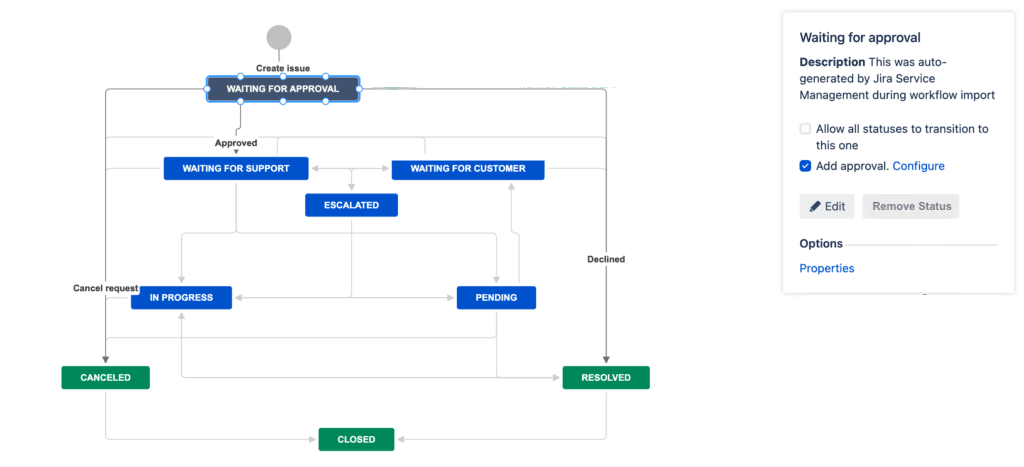
Jira has its own approval feature. You add an approval step to a status of a workflow. When a work item reaches this status, the approvers are notified and approve or decline it. Then the work item moves on to the next status.
The approval step is a built-in feature of Jira Service Management. In other spaces, approvals require Jira Premium or Enterprise (learn more ). Setting up approvals requires admin permissions.
In an ITSM service space, the fields Approvers and Approver groups already exist to add individual approvers or groups of approvers. You can also create your own approval fields.
To set up an approval, you make two settings:
Add the Approval Step to the Workflow
Open the workflow of your space and add an approval step to the status that needs approval. Atlassian’s guide Add an approval step to a workflow shows how.
Define the Approvers
In your service space, open Space settings, then Request management, then Request types. Select a request type and define who approves it. Atlassian’s guide Define approvers for a request type shows how.
These steps apply to company-managed spaces. For team-managed service spaces, see Add an approval step in team-managed service spaces .
What’s Next?
- BPMN Gateways & Decision Handling: Learn how XOR gateways evaluate conditions.
- Add an approval step to a workflow : Atlassian’s guide for Jira workflows.
- Define approvers for a request type : Atlassian’s guide for approvers.