Top 20 BPM Software 2026: Which Platforms Really Automate BPMN?
A team has to choose BPM software. It starts with an analyst report that lists twenty vendors. It reads the vendors’ own pages, where every product leads its field. It looks for prices and finds “contact sales”. One report ranks platforms for automation, a second ranks process mining tools, a third ranks low-code platforms, and the same names appear in all three with different strengths. After two weeks the team has a long list and no way to put the candidates side by side. (The scene is a composite of many evaluations, not the story of one customer.)
This article is the side-by-side view: 20 systems, the same columns for each, and every cell a published fact with its source. It also answers a question that most lists skip: which of these systems actually run a BPMN 2.0 model, and how much of BPMN their engines execute.
The focus is BPMN automation of human work and management processes: approvals, onboarding, requests, changes, and the decisions between them, with AI agents working alongside people. The orchestration of microservices and the control of machines are not the subject, even where a system is strong at them. Systems built for that are in the list because buyers compare them, and the article says where they fit.
In short: There is no single best BPM software. The choice depends on what you automate (people, systems, or both), on who builds the processes, and on where people already work. Appian, Pega, ServiceNow, and UiPath are the Leaders of the 2026 Gartner Magic Quadrant for Business Orchestration and Automation Technologies and fit enterprise-wide automation programs. Camunda and Flowable fit developers who run BPMN at volume. ARIS, Celonis, and SAP Signavio fit teams that first want to analyze how their processes really run. Teams that work in Microsoft 365, ServiceNow, or Jira can run processes on the platform they already have. Only eight of the 20 systems run the BPMN model itself, and none of them executes all of BPMN.
Last updated: November 2026. All sources were accessed between 15 and 16 November 2026.
Key Takeaways
- The market has a new name. Gartner retired its Magic Quadrant for intelligent BPM suites and now covers the market as Business Orchestration and Automation Technologies (BOAT). The second edition is dated 14 September 2026 and assesses 20 vendors. [1, 2]
- Four Leaders. Appian, Pega, ServiceNow, and UiPath are the Leaders of the 2026 edition, according to their own announcements and trade press. Camunda says it is a Visionary. [4, 97]
- Automating is not the same as automating BPMN. Of the 20 systems, 19 run processes, but only eight run a BPMN 2.0 model directly: Bizagi, Bonita, Camunda, Flowable, Jira & Flower BPM, ProcessMaker, TIM Flow, and UiPath Maestro. Most large platforms use their own notation and convert a BPMN file on import.
- No engine executes all of BPMN. Counted against one catalog of 55 elements, the eight engines execute between 8 and 48 of them according to their documentation. Lanes that assign tasks at run time, the core of BPMN for human work, are documented by only three of them. See Who Runs Processes, and Who Runs BPMN?
- Prices are rarely public. Two systems publish complete list prices: Jira & Flower BPM and Microsoft Power Automate. Eleven publish a free edition or some amounts, seven only quote.
- RPA and AI agents are different things. A software robot operates a user interface, an AI agent works from a prompt. Ten systems offer both, eight only agents.
- Most systems bring their own task inbox. A few put tasks into a tool many people already use: Microsoft Power Automate into Outlook and Teams, ServiceNow into ServiceNow, Jira & Flower BPM into Jira.
- Thirteen of the 20 can be self-managed. Kissflow, Microsoft Power Automate, and the SAP services are cloud only.
Which BPM Software Fits Which Situation?
| Your situation | Systems to look at first |
|---|---|
| Enterprise-wide automation program with process mining, RPA, and AI agents | Appian, Pega Platform, ServiceNow, UiPath |
| Developers orchestrate services and human tasks with BPMN at volume | Camunda, Flowable |
| Process analysis and mining first, automation later | ARIS, Celonis, SAP Signavio |
| Document- and case-heavy work | Flowable, NewgenONE, Nintex, Pega Platform |
| Human workflows that business teams build themselves | Bizagi, Creatio, Kissflow, ProcessMaker, TIM Flow |
| Work that already lives in a work-management tool | Jira & Flower BPM, ServiceNow |
| A Microsoft 365 organization | Microsoft Power Automate |
| Regulated or self-managed operation | Appian, Bizagi, Bonita, Camunda, Creatio, Flowable, IBM Business Automation Workflow, NewgenONE, Nintex, Pega Platform, ProcessMaker, TIM Flow, UiPath |
Each situation is described in The Buyer Situations, One by One. The questions that lead to a choice are in How to Choose BPM Software.
Which Analyst Reports Cover BPM Software in 2026?
BPM software is software to model, run, and improve business processes. Analysts no longer treat it as one market. Four reports matter in 2026:
- Gartner Magic Quadrant for Business Orchestration and Automation Technologies (BOAT). This is the successor of the Magic Quadrant for Intelligent Business Process Management Suites, whose last edition we could find is dated 30 January 2019. [11] Gartner describes BOAT platforms as platforms that combine process orchestration, connectivity, and agentic features. The first edition appeared on 15 October 2025, the second on 14 September 2026. The 2026 edition lists 20 vendors: Amazon Web Services, Appian, Automation Anywhere, Bizagi, Boomi, Camunda, Flowable, IBM, Mendix, Microsoft, n8n, Nintex, OutSystems, Pega, Salesforce, SAP, ServiceNow, SS&C Blue Prism, UiPath, and Workato. [1, 2] The companion Critical Capabilities report scores the products in five use cases. Appian says it ranks first for deterministic workflow automation and for platform consolidation, Pega for case management and adaptive work, and ServiceNow for agent governance and runtime control. [3, 39, 47, 53]
- Gartner Magic Quadrant for AI-Augmented Low-Code Application Platforms (28 September 2026, 13 vendors), until 2025 called Enterprise Low-Code Application Platforms. It includes Appian, Microsoft, Pega, and ServiceNow. [5, 6]
- Gartner Magic Quadrant for Process Intelligence Platforms (5 May 2026, 13 vendors), the successor of the process mining quadrant. Trade press names ARIS, Celonis, Pegasystems, and SAP Signavio as Leaders. [7, 8]
- Forrester Wave reports. Trade press names Appian, IBM, Pegasystems, Salesforce, and ServiceNow as Leaders of the Digital Process Automation Software Wave of Q3 2025, and Celonis, ARIS, and iGrafx as Leaders of the Process Intelligence Software Wave of Q3 2025. Camunda says it is a Leader of the Adaptive Process Orchestration Software Wave of Q3 2026. [12, 13, 14]
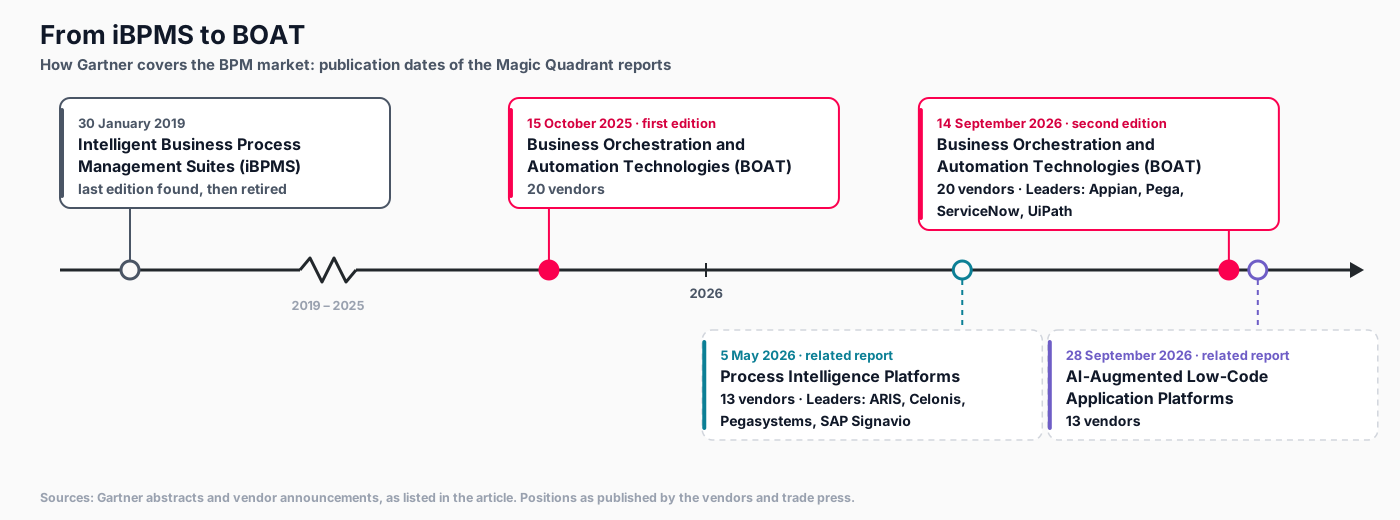
From iBPMS to BOAT: the dates of the reports, without positions in a quadrant. Sources as listed below.
Gartner also keeps a Magic Quadrant for Robotic Process Automation (24 June 2026) and a Market Guide for Business Process Automation Tools (13 July 2026). [9, 10]
Two limits of this section: The full reports are behind a paywall, so quadrant positions here come from the vendors’ own announcements and from trade press. Where a vendor has not published its position, the table says “Included” and nothing more. And nine of the 20 systems are not in the BOAT report: ARIS and Celonis, which are covered as process intelligence platforms, Bonita, Creatio, Jira & Flower BPM, Kissflow, NewgenONE (in the 2025 edition only), ProcessMaker, and TIM Flow. [1, 2]
The 20 Systems at a Glance
The table starts in alphabetical order and highlights no system. Select a column header to sort it, for example by vendor revenue, by founding year, or by the number of BPMN elements executed. The first column stays in place when you scroll sideways. The name of each system leads to its section below.
In alphabetical order. Select a column header to sort. Scroll sideways for all columns.
| Sources | |||||||||||||||||
|---|---|---|---|---|---|---|---|---|---|---|---|---|---|---|---|---|---|
| AppianAppian Corporation | Low-code process platform | 1999per company profiles | Public (Nasdaq: APPN) | USD 726.9MFY2025 | Yes | PartialBPMN-based notation; BPMN files through a utility | Noown process model objects | Not applicableown notation | YesProcess HQ | RPA and AI agentsAppian RPA; Agent Studio | Yes | Yes | Appian task list (Tempo, Sites, mobile) | Third-party plug-inby Vuram on AppMarket | Partialtiers named, no amounts; free Community Edition | Leader | 33, 34, 35, 37, 38, 39, 4 |
| ARISARIS (formerly part of Software AG) | Process modeling and process mining | 1992ARIS method; independent company since 2025 | Private (Silver Lake) | Not disclosed | Nomodeling and analysis; the processes run in other systems | Yes | Nomodeling and analysis, no engine | Not applicableno engine | YesARIS Process Mining | None foundAI assistant for modeling; no robots or agents that run tasks | No | Not verifiedNot verified | Not applicable (no process execution) | None found | Noquote | Not includedLeader in the Process Intelligence MQ 2026 | 135, 136, 137, 138, 139, 1, 8 |
| BizagiBizagi | Low-code BPM suite | 1989 | Private | Not disclosed | Yes | Yesfree Bizagi Modeler | Yesmodels are automated in Bizagi Studio | 32 of 5510 partial, 5 not documented | No | AI agentsBizagi AI Agents; RPA through partner integrations | Yes | Yes | Bizagi Work Portal | Vendor connectorConnectors Xchange | Partialfree Modeler; platform by quote (consumption-based) | Includedposition not published by the vendor | 98, 99, 100, 101, 102, 103, 1 |
| BonitaOfelia (formerly Bonitasoft) | Open-source BPM platform | 2009 | Private equity (Fortino Capital) | Not disclosed | Yes | YesBonita Studio | Yes | 35 of 551 partial, 1 not documented | Not verifiedOfelia Process Intelligence is listed; not verified | AI agentsOfelia Agentic (vendor announcement); no RPA found | YesUI Designer | Yes | Bonita User Application | Vendor connectorJira and Confluence connectors | Partialfree edition (150 process instances per month); Enterprise by quote | Not included | 116, 117, 118, 119, 120, 121, 1 |
| CamundaCamunda | Process orchestration engine | 2008 | Private (venture-backed) | ARR near USD 200Mrecurring revenue, August 2026 | Yes | Yes | Yessee the vendor's BPMN coverage page | 48 of 552 not documented | NoOptimize is process analytics | RPA and AI agentsown RPA; AI agent connector | Partialforms and Tasklist | Yesproduction use needs an enterprise license | Camunda Tasklist or a custom app through the API | Marketplace connectorpublished by Infosys | Partialfree for non-production self-managed use; otherwise quote | Visionary | 88, 89, 90, 91, 92, 93, 94, 95, 97 |
| CelonisCelonis | Process mining and process intelligence | 2011 | Private (venture-backed) | Not disclosed | YesOrchestration Engine, since 2025 | YesCelonis Process Management | Not verifiedOrchestration Engine; BPMN not stated | Not verifiedwhether the engine runs the BPMN model is not documented | Yescore product | AI agentsAgentC; no RPA found | Not verifiedNot verified | Not verifiedNot verified | Human tasks inside Celonis orchestrations | Vendor connectorreads Jira Cloud data for mining | Noquote | Not includedLeader in the Process Intelligence MQ 2026 | 131, 132, 133, 134, 1, 8 |
| CreatioCreatio | No-code workflow and CRM platform | Not verifiednot stated by the vendor | Private (Sapphire Ventures and others) | Not disclosed | Yes | PartialBPMN-based Process Designer with its own elements; .bpmn import | Partialimported BPMN is converted; boundary events are not executable | Not applicableBPMN is converted on import | Noprocess log, no mining found | AI agentsCreatio AI agents; no RPA robots found | Yes | YesEnterprise and Unlimited plans | Creatio (notification panel, activities of the record) | Third-party connectorimports Jira data | PartialGrowth USD 40 and Enterprise USD 75 per user/month; Unlimited by quote; minimum USD 10,000 per year | Not included | 188, 189, 190, 191, 192, 193, 194, 195, 197, 1 |
| FlowableFlowable AG | BPMN, CMMN and DMN engine platform | 2010 | Private | Not disclosed | Yes | Yes | Yes | 35 of 553 partial, 16 not documented | No | AI agentsAI Studio; no RPA found | YesFlowable Design | Yes | Flowable Work | None found | Partialopen-source engines (Apache 2.0); enterprise by quote | Includedposition not published by the vendor | 111, 112, 113, 114, 115, 1 |
| IBM Business Automation WorkflowIBM | BPM suite | 1911 | Public (NYSE: IBM) | USD 67.5bnIBM, FY2025; product not disclosed | Yes | Partialown process definitions; BPMN 2.0 import and export | Partiala BPMN import is converted into IBM workflow objects | Not applicableBPMN is converted on import | YesIBM Process Mining | RPA and AI agentsIBM RPA; watsonx Orchestrate agents | YesApplication Designer | Yes | IBM Process Portal / Workplace | Through watsonx Orchestratenone for the workflow product found | Partialnone for the workflow product; watsonx Orchestrate from USD 578/month | Includedposition not published by the vendor | 69, 70, 71, 72, 73, 74, 1 |
| Jira & Flower BPMAtlassian Jira with the BPMN app Flower BPM | Work management with a BPMN engine | 2002Atlassian | Public (Atlassian, Nasdaq: TEAM) | USD 6,572MAtlassian, FY2026; product not disclosed | Yes | Yesmodeler inside Jira | Yeshuman tasks, gateways, timers, events, sub-processes; automated tasks through Jira Automation rules | 43 of 552 partial | No | AI agentsRovo agents, called from Jira Automation rules; no RPA robots | NoJira forms and fields, no app builder | PartialJira Data Center, for existing customers, until March 2029 | Jira work items (boards, queues, Jira Service Management) | Runs inside Jira | YesJira Standard USD 8.48 per user/month plus the Flower app USD 2.80 (free up to 10 users) | Not includedAtlassian: Leader in the ITSM Platforms MQ 2026 | 15, 16, 17, 18, 20, 21, 27, 29, 31, 1, 19 |
| KissflowKissflow Inc. | Low-code and no-code work platform | 2003as OrangeScape; Kissflow product 2012 | Private | Not disclosed | Yes | Noown workflow builder; no BPMN documented | No | Not applicableown notation | No | Not verifiedno RPA found; AI agents not verified | Yescore product | Nocloud only | Kissflow | Vendor connector | Partialquote; a Kissflow article names USD 2,500/month as the starting price | Not included | 127, 128, 129, 130, 1 |
| Microsoft Power AutomateMicrosoft Corporation | Flow automation and RPA (cloud) | 1975 | Public (Nasdaq: MSFT) | USD 331,839MMicrosoft, FY2026; product not disclosed | Yes | Noflow designer; process mining exports BPMN | NoJSON flow definitions | Not applicableown notation | YesPower Automate Process Mining | RPA and AI agentsPower Automate for desktop; Copilot Studio agents | YesPower Apps | Nocloud service only | Outlook, Microsoft Teams, Power Automate action center | Vendor connectorpremium connector | YesPremium USD 15 per user/month | Includedposition not published by the vendor | 54, 55, 56, 57, 58, 59, 60, 61, 1 |
| NewgenONENewgen Software Technologies Ltd. | Low-code process and content platform | 1992 | Public (NSE/BSE: NEWGEN) | INR 1,574 croreFY2026 (March 2026) | Yes | Partialprocess designer with a BPMN view; BPMN 2.0 export | Not verifiedBPMN 2.0 documented as an import and export format; execution of the BPMN model not documented | Not verifiedwhether the engine runs the BPMN model is not documented | YesProcess Insights | RPA and AI agentsown RPA; agentic AI (vendor statement) | Yes | Yes | NewgenONE workplace | None found | Noquote | Not includedNiche Player in the 2025 edition | 155, 156, 157, 158, 1, 2 |
| NintexNintex | Workflow automation and process documentation | 2006 | Private equity (TPG, Thoma Bravo) | Not disclosed | Yes | Partialin Nintex Process Manager, for documentation | Noown workflow designer | Not applicableown notation | PartialNintex Process Discovery | RPA and AI agentsNintex RPA; Agent Designer in beta | Yesforms and apps | YesNintex Automation K2 | Nintex task forms | Vendor connector | Noquote | Includedposition not published by the vendor | 104, 105, 106, 107, 108, 109, 110, 1 |
| Pega PlatformPegasystems Inc. | Low-code case management platform | 1983 | Public (Nasdaq: PEGA) | USD 1,745.8MFY2025 | Yes | Nocase types with stages and steps | NoBPMN only as input to Pega Blueprint | Not applicableown notation | YesPega Process Mining | RPA and AI agentsPega RPA; Pega AI agents | Yes | Yesclient-managed cloud | Pega worklist and work queues | Marketplace componentfor the development backlog | Noquote; free trial | Leader | 41, 42, 43, 44, 45, 46, 47, 4 |
| ProcessMakerDecisions (merged with ProcessMaker, 2025) | Low-code BPM platform | Not verified | Private | Not disclosed | Yes | YesBPMN-based Process Modeler | Yes | 33 of 551 partial, 21 not documented | Yesprocess intelligence (Workfellow) | AI agentsagent tooling of Decisions; no RPA found | Yesform designer | Yesopen-source core | ProcessMaker task inbox | None found | Partialopen-source core (AGPL-3.0); otherwise quote | Not included | 122, 123, 125, 126, 1 |
| SAP Signavio + SAP Build Process AutomationSAP SE | Process modeling and mining plus automation | 1972SAP; Signavio 2009, acquired 2021 | Public | EUR 36.80bnSAP, FY2025; products not disclosed | Yes | YesSAP Signavio Process Manager | Partiala BPMN import is converted, with placeholders for unsupported elements; lanes are not taken over | Not applicableBPMN is converted on import | YesSAP Signavio Process Intelligence | RPA and AI agentsRPA in Build Process Automation; Joule agents | YesSAP Build | Nocloud services; none found | SAP My Inbox / SAP Task Center | Through SAP Integration SuiteJira receiver adapter | Partialsome prices published; plan prices not verified | Includedposition not published by the vendor | 75, 76, 77, 78, 82, 80, 81, 87, 83, 84, 85, 86, 1 |
| ServiceNowServiceNow, Inc. | Workflow platform (ITSM origin) | 2004 | Public (NYSE: NOW) | USD 13,278MFY2025 | Yes | Noflows, subflows, playbooks | No | Not applicableown notation | YesServiceNow Process Mining | RPA and AI agentsRPA Hub; ServiceNow AI agents | YesApp Engine | PartialPrivate Stack; most customers use the cloud | ServiceNow (My Approvals, Employee Center, mobile) | Vendor connectorJira spoke, needs Integration Hub | Noquote | Leader | 48, 49, 51, 52, 53, 4 |
| TIM FlowTIM Solutions GmbH | Workflow platform for human tasks | 2002commercial register | Private (Loom Holding GmbH) | Not disclosed | Yes | Yesown designer or BPMN 2.0 models from other tools | YesBPMN files are imported into Workflow Design; documented subset: user and script tasks, XOR and AND gateways, sub-processes; whether the engine keeps the BPMN XML is not stated | 8 of 5510 partial, 37 not documented | Noprocess analytics, no mining found | AI agentsAI agents as process steps; no RPA found | Yesform designer | Yescloud service, single-tenant, or on-premise | TIM Flow task list and task e-mails | None foundREST and file connectors | Noquote; licence by users | Not included | 141, 142, 145, 146, 187, 185, 147, 148, 143, 149, 144, 150, 151, 1 |
| UiPath (Maestro)UiPath, Inc. | RPA with BPMN orchestration | 2005 | Public (NYSE: PATH) | USD 1,611MFY2026 (January 2026) | Yes | YesMaestro | Yesa documented subset; lanes, loops and several event types are model-only | 30 of 552 partial, 1 not documented | YesUiPath Process Mining | RPA and AI agentsrobots are the core product; Agent Builder | YesUiPath Apps | Yes | UiPath Action Center | Vendor connectorJira Cloud only | PartialBasic from USD 25/month; higher plans on request; free Community plan | Leader | 62, 63, 64, 66, 67, 68, 4 |
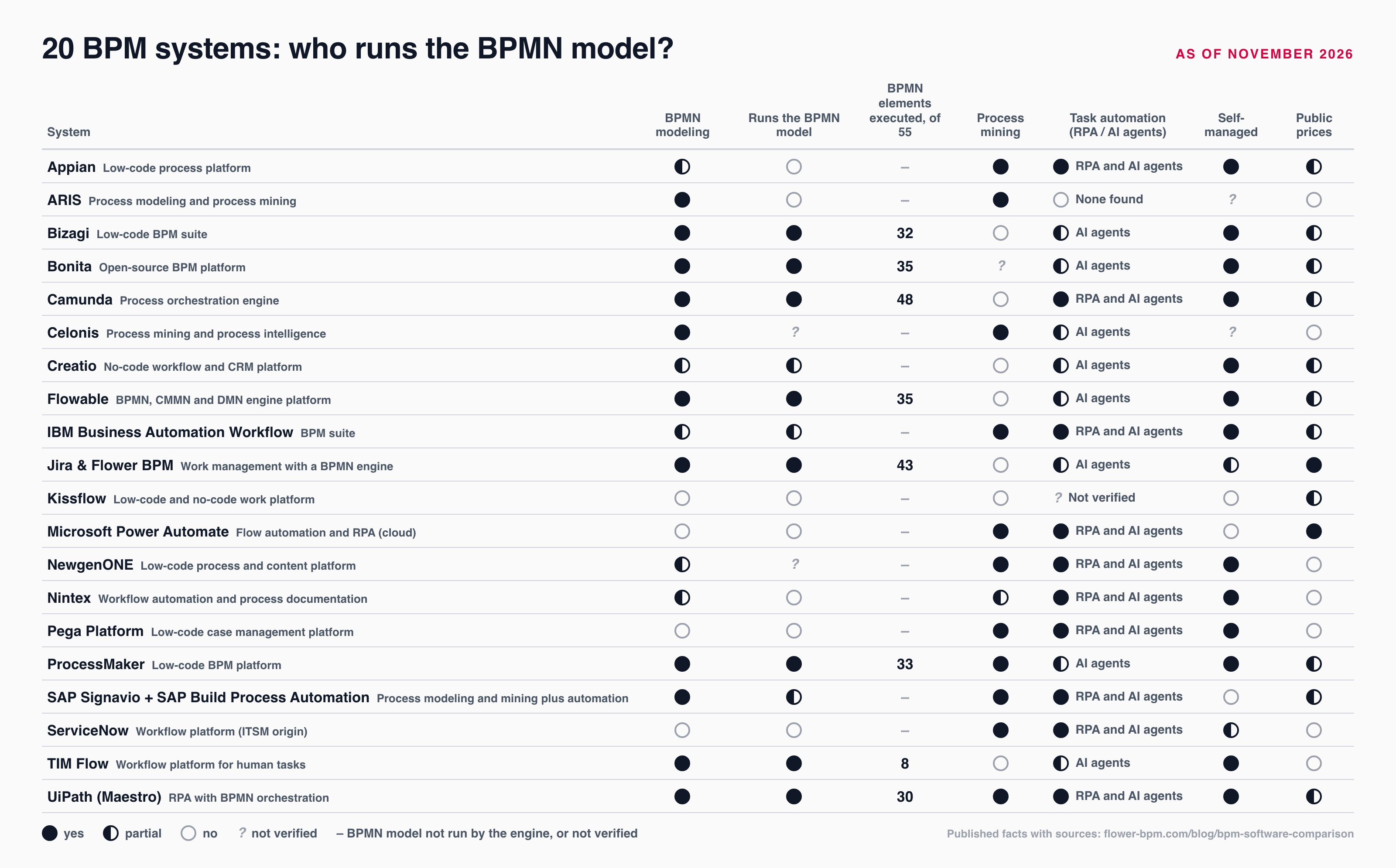
The capabilities at a glance, from the same data as the table. A half-filled dot means partial, a question mark means not verified. The count of BPMN elements is explained in the section on BPMN coverage.
How to Read the Table
- Vendor revenue is the revenue of the whole company in its latest full fiscal year, as the company published it. For Microsoft, IBM, SAP, and Atlassian it says little about the product, because none of them publishes product revenue. Private companies are “Not disclosed” unless they published a figure themselves. We use no third-party estimates.
- Runs processes: Yes means the system has an engine of its own that runs processes. No means it models and analyzes, and the processes run in other systems.
- BPMN 2.0 modeling: Yes means processes are modeled in BPMN 2.0. Partial means a BPMN-like notation or BPMN in a separate documentation tool. No means another notation.
- Runs the BPMN model: Yes means the engine runs the BPMN 2.0 model itself. Every such vendor documents which elements it executes, and none executes all of them. Partial means BPMN is imported and converted into the vendor’s own format.
- BPMN elements executed: how many elements of a fixed catalog of 55 BPMN 2.0 elements the vendor documents as executed, for the eight engines that run the BPMN model itself. The count, the catalog, and every element per system are in Who Runs Processes, and Who Runs BPMN? “Not applicable” means the engine does not run a BPMN model.
- Task automation (RPA / AI agents): RPA means software robots that operate user interfaces. AI agents are agents built on language models that carry out a task from a prompt. The cell says which of the two the vendor offers: both, AI agents only, or none found. An AI agent is not a screen robot, so the two are named separately. Agent offerings are the vendors’ own descriptions.
- Self-managed: whether you can run the system on your own infrastructure.
- Jira integration: from “runs inside Jira” through a connector built by the vendor to a connector by a third party. “None found” means we found none in the vendor’s documentation, not that none exists.
- Public prices: Yes means list prices with amounts on the vendor’s site. Partial means a free edition or some amounts. No means quote only.
- No scores. The table has no rating column. Every cell is a published fact or “Not verified”.
Who Runs Processes, and Who Runs BPMN?
Most BPM lists treat “supports BPMN” as one checkbox. For a buyer, three different things hide behind it: whether the system runs processes at all, whether it runs the BPMN model you drew, and how much of BPMN its engine executes.
Three Groups
- No engine. ARIS models and analyzes processes. We found no engine: the processes themselves run in other systems.
- An engine with its own format. Appian, Creatio, IBM Business Automation Workflow, Kissflow, Microsoft Power Automate, Nintex, Pega Platform, SAP Build Process Automation, and ServiceNow run processes in their own notation. Where they accept a BPMN file, they convert it: IBM maps BPMN constructs to its own workflow objects and leaves out what it cannot map, [72] SAP Build Process Automation sets placeholders for unsupported elements and does not take over lanes, [80, 81] and Creatio imports boundary events as elements that are not executed and leaves out pools and message flows. [189] After the import, the vendor’s model is what runs, not the BPMN file. For NewgenONE and Celonis, the documentation we could read does not show that the engine runs a BPMN model: NewgenONE describes BPMN 2.0 as an import and export format, and the Celonis documentation is behind a login.
- The BPMN model is what runs. Bizagi, Bonita, Camunda, Flowable, Jira & Flower BPM, ProcessMaker, TIM Flow, and UiPath Maestro execute the BPMN 2.0 model itself. The diagram that business and IT agreed on is the program, and it stays readable by other BPMN tools.
How Much of BPMN Do the Engines Execute?
No engine executes all of BPMN 2.0, and every vendor documents its own subset in its own words. To put the eight engines side by side, we read each vendor’s documentation against one fixed catalog of 55 BPMN elements in ten groups. The table counts what each engine executes, by group, and adds the facts that decide how well an engine handles human work.
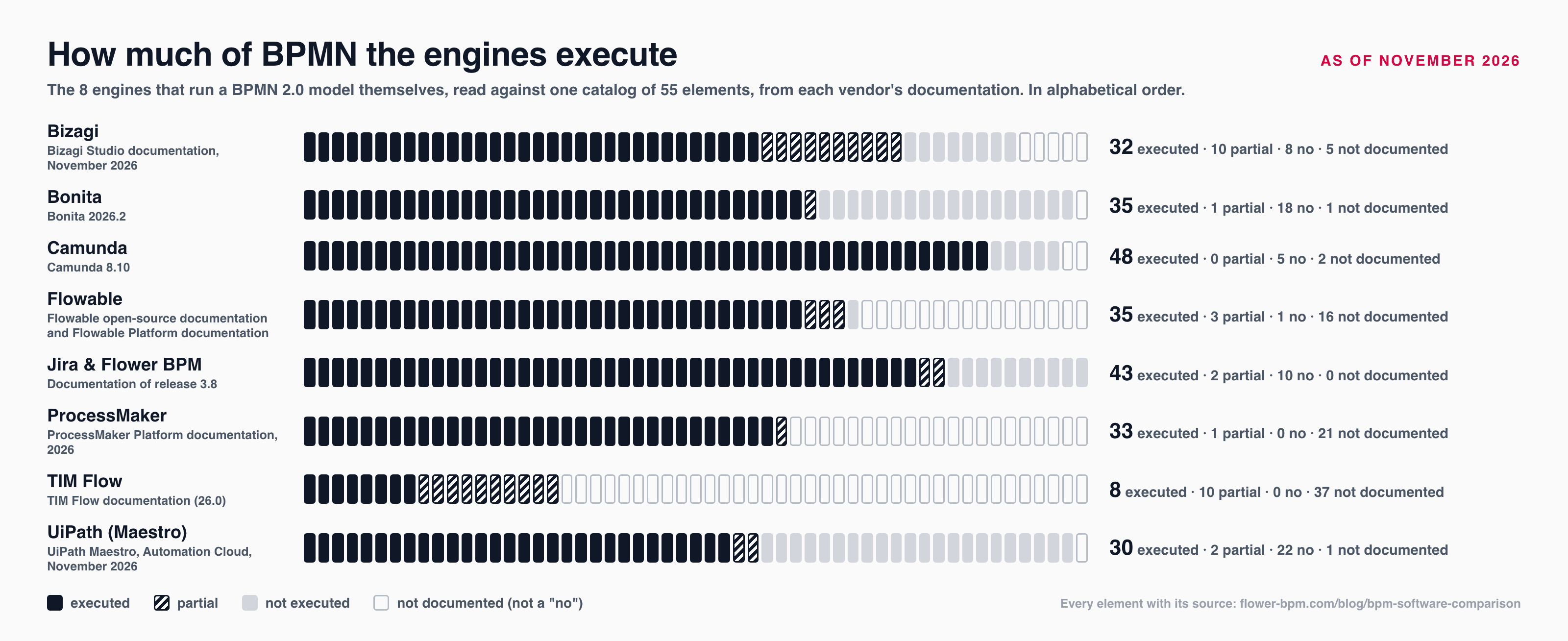
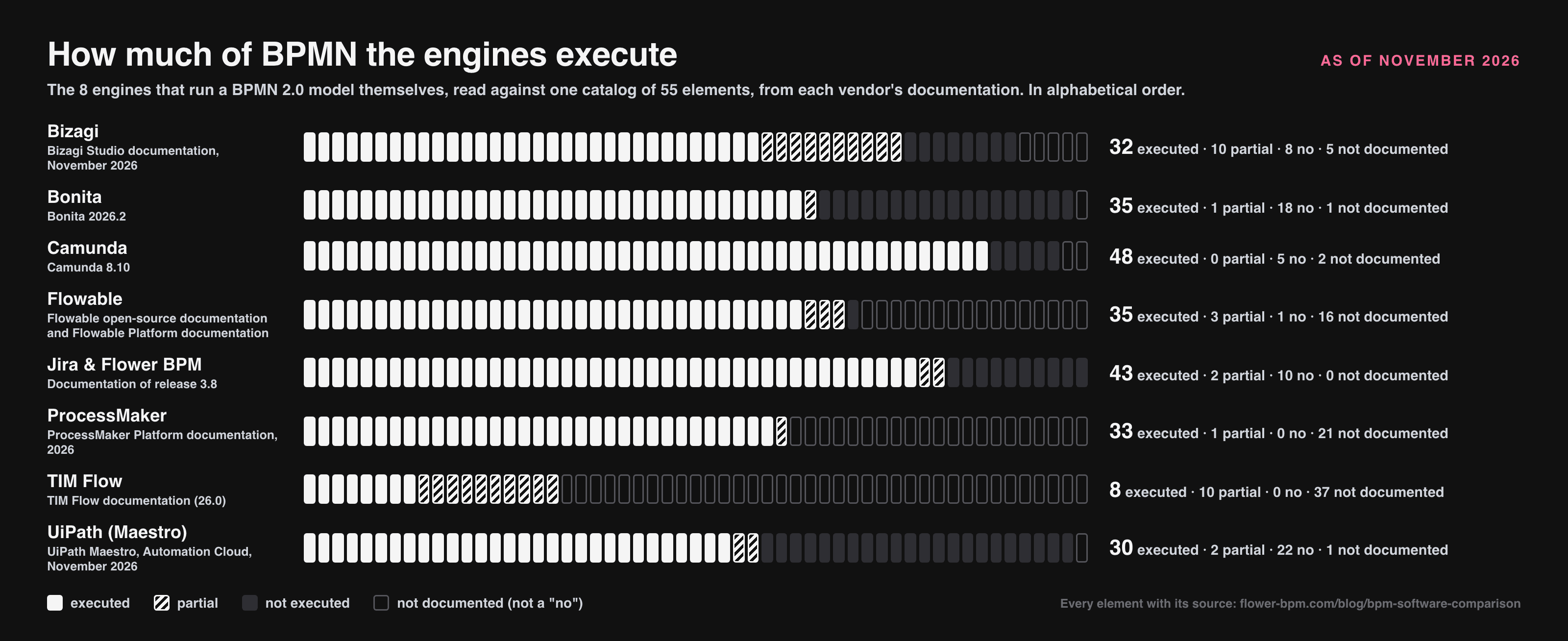
The 55 elements of the catalog per engine, from the same data as the tables below. An empty box means the documentation does not mention the element.
In alphabetical order. Select a column header to sort. Scroll sideways for all columns.
| Sources | |||||||||||||
|---|---|---|---|---|---|---|---|---|---|---|---|---|---|
| BizagiBizagi Studio documentation, November 2026 | 32 of 5510 partial, 5 not documented | 5 of 83 partial | 3 of 52 not documented | 0 of 32 partial, 1 not documented | 5 of 5 | 19 of 324 partial, 2 not documented | Noperformers are set on each activity | Partialon reusable sub-processes only | Yes | YesForms Designer | PartialLive Processes for simple processes; otherwise Bizagi Studio and a deployment | Bizagi Work Portal | 177, 178, 179, 180, 181 |
| BonitaBonita 2026.2 | 35 of 551 partial, 1 not documented | 6 of 8 | 1 of 51 partial, 1 not documented | 3 of 3 | 3 of 5 | 20 of 32 | Yesthe actor of the lane applies unless the task names its own | Yes | Yes | Partialgenerated for development; production needs a form built in the UI Designer | NoBonita Studio, actor mapping, and forms | Bonita User Application | 165, 166, 167, 168, 169, 170, 171, 172 |
| CamundaCamunda 8.10 | 48 of 552 not documented | 8 of 8 | 4 of 5 | 2 of 3 | 4 of 5 | 30 of 32 | Not documentedpool and lane are marked as executable; assignment is set on the user task, and the documentation describes no assignment through the lane | Yes | Yes | YesCamunda Forms, linked to the user task | Yesin the cloud service; self-managed needs an installed cluster | Camunda Tasklist or a custom app through the API | 91, 159, 160 |
| FlowableFlowable open-source documentation and Flowable Platform documentation | 35 of 553 partial, 16 not documented | 5 of 81 partial, 2 not documented | 4 of 51 partial | 2 of 31 not documented | 4 of 51 not documented | 20 of 321 partial, 11 not documented | Not documentedthe documentation says user tasks "can benefit" from lanes and does not say how | Yes | Yes | PartialFlowable Platform (Flowable Design); the open-source engine ships no form designer | PartialFlowable Platform; the open-source engine is set up with Java or its REST API | Flowable Work | 161, 162, 163, 164 |
| Jira & Flower BPMDocumentation of release 3.8 | 43 of 552 partial | 8 of 8 | 3 of 5 | 0 of 31 partial | 4 of 5 | 26 of 321 partial | Yes | Nothe task runs once | Yes | YesJira fields and forms | Yesmodeled and started inside Jira | Jira work items (boards, queues, Jira Service Management) | 21, 22 |
| ProcessMakerProcessMaker Platform documentation, 2026 | 33 of 551 partial, 21 not documented | 3 of 85 not documented | 1 of 54 not documented | 3 of 3 | 3 of 51 partial, 1 not documented | 22 of 3210 not documented | Not documenteda lane "indicates" a role; assignment is set on each task | Yes | Yes | YesScreen Builder | YesPublish in the Process Modeler | ProcessMaker task inbox | 173, 174, 175, 176 |
| TIM FlowTIM Flow documentation (26.0) | 8 of 5510 partial, 37 not documented | 1 of 83 partial, 4 not documented | 0 of 51 partial, 4 not documented | 0 of 33 not documented | 2 of 53 not documented | 4 of 326 partial, 22 not documented | Yesevery swimlane is assigned to a user or a group | Not documented | Not documenteddeadlines use the escalation boundary event | YesForm Designer | Partialthe model comes from an external BPMN tool and is set up in Workflow Design | TIM Flow task list and task e-mails | 146, 185, 186, 187 |
| UiPath (Maestro)UiPath Maestro, Automation Cloud, November 2026 | 30 of 552 partial, 1 not documented | 7 of 81 partial | 2 of 51 partial, 1 not documented | 2 of 3 | 4 of 5 | 15 of 32 | Nolanes are layout only | Yes | Yes | Partialan action app per user task, built in UiPath Apps | Partialneeds an action app per user task and a folder with robot runtimes | UiPath Action Center | 64, 182, 183, 184 |
How to read it:
- Executed means the vendor documents the element as executed. Partial means it runs with a documented limit, named in the note of the cell.
- “Not documented” is not “no”. It means the pages we read do not mention the element. For TIM Flow, ProcessMaker, and Flowable, many elements are not documented (37, 21, and 16 of 55), so their counts are a lower bound.
- A higher count is not a better fit. Camunda documents the widest set, 48 of 55, which suits the orchestration of services: service tasks, messages, and multi-instance activities. A process of human tasks depends on fewer elements, but on different ones: lanes, deadlines, forms, and the place where a task lands.
Every Element, Engine by Engine
The matrix shows every element of the catalog for every engine. Point at a mark to read its note.
| Element | Bizagi | Bonita | Camunda | Flowable | Jira & Flower BPM | ProcessMaker | TIM Flow | UiPath (Maestro) |
|---|---|---|---|---|---|---|---|---|
| Tasks | ||||||||
| User task | Executed | Executed | Executed | Executed | Executed | Executed: called Form Task | Executed | Executed: with an action app built in UiPath Apps |
| Manual task | Executed | Not executed | Executed: passed, the engine does not wait | Executed | Executed | Executed | Not documented | Executed |
| Undefined task | Partial: runs as a user task | Executed: runs like a service task | Executed: passed, the engine does not wait | Not documented | Executed | Not documented | Partial: runs as a human task | Executed |
| Service task | Executed | Executed | Executed: needs a job worker or connector | Executed | Executed: with Wait for Jira Automation (a rule does the work); without it the task is passed | Not documented | Not documented | Executed |
| Script task | Partial: documented for custom e-mail notifications | Executed | Executed | Executed | Executed: with Wait for Jira Automation; the script itself never runs on the server | Executed | Partial: with an action handler | Executed |
| Business rule task | Partial: named in the automation guidance; no properties page | Not executed | Executed | Executed | Executed: with Wait for Jira Automation | Not documented | Not documented | Partial: preview |
| Send task | Executed | Executed | Executed: needs a job worker or connector | Not documented | Executed: with Wait for Jira Automation | Not documented | Partial: sends e-mails | Executed: through Integration Service connectors |
| Receive task | Executed | Executed | Executed | Partial: a wait state continued through the API | Executed: a comment with @FlowerBPM, Jira Automation or the REST endpoint (Data Center) sends the message | Not documented | Not documented | Executed: through Integration Service connectors |
| Sub-processes | ||||||||
| Embedded sub-process | Executed | Not executed: not offered; imported as a call activity | Executed | Executed | Executed | Not documented | Not documented | Executed |
| Call activity | Executed | Executed | Executed | Executed | Executed | Executed: called Sub Process | Partial: the symbol "hidden sub-process" | Executed |
| Event sub-process | Not documented | Partial: interrupting only | Executed | Executed | Executed: conditional, timer, error, message, signal and escalation start events | Not documented | Not documented | Partial: marked as executed, but no start event inside an event sub-process is marked as executed |
| Transaction | Executed | Not documented | Not executed | Executed | Not executed: runs like an embedded sub-process | Not documented | Not documented | Not executed |
| Ad-hoc sub-process | Not documented | Not executed | Executed | Partial: Flowable Platform only; activities are started through the API | Not executed: runs like an embedded sub-process | Not documented | Not documented | Not documented |
| Markers | ||||||||
| Multi-instance, parallel | Partial: on reusable sub-processes only | Executed | Executed | Executed | Not executed: the task runs once | Executed | Not documented | Executed |
| Multi-instance, sequential | Partial: on reusable sub-processes only | Executed | Executed | Executed | Not executed: the task runs once | Executed | Not documented | Executed |
| Loop | Not documented | Executed | Not executed | Not documented | Partial: on tasks with a loop condition (a status or resolution of the work item, or an expression); on sub-processes and call activities it runs once | Executed | Not documented | Not executed |
| Gateways | ||||||||
| Exclusive gateway | Executed | Executed | Executed | Executed | Executed | Executed | Executed | Executed |
| Parallel gateway | Executed | Executed | Executed | Executed | Executed | Executed | Executed | Executed |
| Inclusive gateway | Executed | Executed | Executed | Executed | Executed | Executed | Not documented | Executed |
| Event-based gateway | Executed | Not executed | Executed | Executed | Executed: the first event behind it takes the path, the others are discarded | Partial: followed by timer or message catch events only | Not documented | Executed |
| Complex gateway | Executed | Not executed | Not executed | Not documented | Not executed: runs like an inclusive gateway | Not documented | Not documented | Not executed |
| Start events | ||||||||
| None start | Executed | Executed | Executed | Executed | Executed | Executed | Executed | Executed |
| Message start | Executed | Executed | Executed | Executed | Executed | Executed | Partial: started by an inbound e-mail | Executed |
| Timer start | Executed | Executed | Executed | Executed | Executed | Executed | Not documented | Executed |
| Signal start | Executed | Executed | Executed | Executed | Executed | Executed | Partial: started by an inbound e-mail | Not executed |
| Conditional start | Not executed | Not executed | Executed | Not documented | Executed | Executed | Not documented | Not executed |
| Intermediate catch events | ||||||||
| Message catch | Executed | Executed | Executed | Executed | Executed | Executed | Not documented | Executed |
| Timer catch | Executed | Executed | Executed | Executed | Executed | Executed | Not documented | Executed |
| Signal catch | Executed | Executed | Executed | Executed | Executed: every waiting process instance gets the signal | Executed | Partial: a wait state continued by hand, by a timer job, or by a handler | Not executed |
| Conditional catch | Executed | Not executed | Executed | Not documented | Executed | Executed | Not documented | Not executed |
| Link (catch and throw) | Executed | Executed | Executed | Not documented | Executed | Not documented | Not documented | Not executed |
| Intermediate throw events | ||||||||
| None throw | Partial: an event that a person performs | Not executed | Executed | Executed | Executed: triggers a Jira Automation rule or a webhook | Not documented | Not documented | Executed |
| Message throw | Executed | Executed | Executed: needs a job worker or connector | Not documented | Executed: Jira Automation or a web service; to another pool of the model through a message flow | Executed | Not documented | Executed |
| Signal throw | Executed | Executed | Executed | Executed | Executed: reaches every process instance that waits for the signal; also triggers a Jira Automation rule or a webhook | Executed | Not documented | Not executed |
| Escalation throw | Not executed | Not executed | Executed | Not documented | Partial: triggers a Jira Automation rule or a webhook; reaches the escalation boundary event of an embedded sub-process around it, not of a call activity | Not documented | Not documented | Not executed |
| Compensation throw | Not executed | Not executed | Executed | Executed | Not executed: triggers the rule like a none throw event, no compensation | Not documented | Not documented | Not executed |
| Boundary events | ||||||||
| Timer boundary, interrupting | Executed | Executed | Executed | Executed | Executed | Executed | Not documented: deadlines use the escalation boundary event | Executed |
| Timer boundary, non-interrupting | Not executed: non-interrupting attached events become interrupting | Executed | Executed | Executed | Executed | Executed | Not documented | Executed |
| Message boundary | Executed | Executed | Executed | Executed | Executed | Executed | Partial: an e-mail reply completes the task | Executed |
| Error boundary | Partial: with a transactional sub-process | Executed | Executed | Executed | Executed: a work item resolved in the status of the error, or an error end event inside | Executed | Executed | Executed |
| Escalation boundary | Not executed | Not executed | Executed | Not documented | Executed: a work item moved into the status of the escalation, or an escalation throw or end event inside | Not documented | Partial: time-based, relative to the duration of the task | Not executed |
| Signal boundary | Not documented | Executed | Executed | Executed | Executed | Executed | Partial: an e-mail reply completes the task | Not executed |
| Conditional boundary | Not documented | Not executed | Executed | Not documented | Executed | Executed | Not documented | Not executed |
| Compensation boundary | Partial: with a transactional sub-process | Not executed | Executed | Partial: not on embedded sub-processes | Not executed: never fires | Not documented | Not documented | Not executed |
| Cancel boundary | Executed | Not executed | Not executed | Executed: on a transaction sub-process | Not executed: never fires | Not documented | Not documented | Not executed |
| End events | ||||||||
| None end | Executed | Executed | Executed | Executed | Executed | Executed | Executed | Executed |
| Message end | Executed | Executed | Executed: needs a job worker or connector | Not documented | Executed: triggers a Jira Automation rule or a webhook; to another pool through a message flow | Executed | Not documented | Executed |
| Error end | Partial: with a transactional sub-process | Executed | Executed | Executed | Executed | Executed | Not documented | Executed |
| Escalation end | Not executed | Not executed | Executed | Not documented | Executed | Not documented | Not documented | Not executed |
| Signal end | Executed | Executed | Executed | Not documented | Executed: reaches every process instance that waits for the signal; also triggers a Jira Automation rule or a webhook | Executed | Not documented | Not executed |
| Terminate end | Executed | Executed | Executed | Executed | Executed | Executed | Executed | Executed |
| Compensation end | Not executed | Not executed | Executed | Not documented | Not executed: ends its flow like a none end event | Not documented | Not documented | Not executed |
| Cancel end | Executed | Not executed | Not executed | Executed | Not executed: ends its flow like a none end event | Not documented | Not documented | Not executed |
| Participants | ||||||||
| Lanes assign tasks at run time | Not executed: performers are set on each activity | Executed: the actor of the lane applies unless the task names its own | Not documented: pool and lane are marked as executable; assignment is set on the user task, and the documentation describes no assignment through the lane | Not documented: the documentation says user tasks "can benefit" from lanes and does not say how | Executed | Not documented: a lane "indicates" a role; assignment is set on each task | Executed: every swimlane is assigned to a user or a group | Not executed: lanes are layout only |
| Several pools with message flows | Partial: each pool is imported as its own process; messages through events | Executed | Not documented: message flows are not described in the element reference | Not executed: one executable process per model; message flows are not considered | Executed | Executed: each pool is its own request | Not documented | Not executed: one pool is executed; message flows have no effect at run time |
| Executed, of 55 | 32 | 35 | 48 | 35 | 43 | 33 | 8 | 30 |
| Sources | 177, 178, 179, 180, 181 | 165, 166, 167, 168, 169, 170, 171, 172 | 91, 159, 160 | 161, 162, 163, 164 | 21, 22 | 173, 174, 175, 176 | 146, 185, 186, 187 | 64, 182, 183, 184 |
BPMN for Human Work
This is the focus of the comparison. Approvals, onboarding, and requests are processes of people, and more and more of them include steps done by AI agents with a person in the loop. For them, four questions matter more than the element count:
- Do lanes assign the tasks? In BPMN, a lane stands for a role. Jira & Flower BPM, Bonita, and TIM Flow document that a task in a lane goes to the people of that lane at run time. [21, 169, 185] In Bizagi, performers are set on each activity, and in UiPath Maestro lanes are layout only. [179, 182] Camunda, Flowable, and ProcessMaker do not document an effect of lanes: assignment is set on each task. [159, 163, 175]
- Where does the task land? In seven of the eight engines, in the system’s own task list or inbox. In Jira & Flower BPM, each task is a Jira work item on the boards and queues the team already uses. [25]
- Forms without code? Jira & Flower BPM (Jira fields and forms), Bizagi, Camunda, ProcessMaker, and TIM Flow come with a form builder or form fields for user tasks. In Bonita, Flowable, and UiPath Maestro a production form needs a separate designer, an enterprise edition, or an app built per task.
- Live without a developer? In Jira & Flower BPM and ProcessMaker, a process of user tasks, gateways, and timers is modeled and published in the product; in Camunda this holds for the cloud service. Bizagi, Flowable, TIM Flow, and UiPath Maestro need a separate design tool, an enterprise edition, or apps and robot runtimes; Bonita needs Bonita Studio and forms. [176, 160, 181, 183, 187, 172]
Where Jira & Flower BPM stands: it is one of three engines whose lanes assign tasks at run time, the only one where tasks land as work items in a tool the team already uses, and, with Microsoft Power Automate, one of two systems in this comparison with complete public list prices. It also executes the escalation boundary event, which hands a decision to a manager while the task stays open. With 43 of 55 elements it executes the second-largest set after Camunda: tasks that a Jira Automation rule does (service, script, send, and business rule tasks with Wait for Jira Automation), messages and signals that arrive through a comment, a rule, or the REST endpoint, and event sub-processes. Not executed are multi-instance markers, transactions, ad-hoc sub-processes, the complex gateway, and compensation and cancel events; a loop marker runs on tasks only. [21, 22] For processes that need these, Camunda, Bonita, or Flowable fit better today.
How to Choose BPM Software: Eight Questions
These questions hold for every buyer. Each one names the systems that answer it well according to the table, in alphabetical order.
- What must be automated: people, systems, or both? Work between people needs a task list, forms, and assignment. Work between systems needs service calls, connectors, and throughput. Built for system orchestration: Camunda and Flowable. With RPA robots for applications without an API: Appian, Camunda, IBM, Microsoft Power Automate, NewgenONE, Nintex, Pega, SAP, ServiceNow, and UiPath. Built around human tasks: Bizagi, Jira & Flower BPM, Kissflow, and TIM Flow. If nobody knows yet how the process runs, start with process mining: ARIS, Celonis, and SAP Signavio.
- Who builds the processes: developers or business teams? Camunda and Flowable are engines for developers. A low-code builder for applications and forms is part of Appian, Bizagi, Bonita, Creatio, Flowable, IBM, Kissflow, Microsoft Power Automate, NewgenONE, Nintex, Pega, ProcessMaker, SAP, ServiceNow, TIM Flow, and UiPath.
- Where do tasks land? In most systems, in the system’s own inbox, which is one more place to check. Microsoft Power Automate sends approvals to Outlook and Teams, ServiceNow keeps tasks in ServiceNow, and Jira & Flower BPM creates Jira work items. Camunda lets you build your own task application on its API.
- BPMN standard or the vendor’s notation, and how much of BPMN? A standard model can be read by other tools and by people trained elsewhere, and what you draw is what runs. The engine runs the BPMN 2.0 model itself in Bizagi, Bonita, Camunda, Flowable, Jira & Flower BPM, ProcessMaker, TIM Flow, and UiPath Maestro. Each executes a documented subset, so check the elements your processes need in the element matrix. Camunda and Flowable also execute DMN decisions. Appian, Creatio, IBM, Kissflow, Microsoft Power Automate, Nintex, Pega, SAP Build Process Automation, and ServiceNow run their own formats, and those that accept a BPMN file convert it on import.
- Where does it run, and where is the data? Self-managed operation is possible with Appian, Bizagi, Bonita, Camunda, Creatio, Flowable, IBM, NewgenONE, Nintex, Pega, ProcessMaker, TIM Flow, and UiPath. Bonita, Flowable, and ProcessMaker have an open-source core. ServiceNow offers a self-hosted variant with limits, and Jira & Flower BPM can be self-managed only on Jira Data Center, which ends in March 2029. Kissflow, Microsoft Power Automate, and the SAP services are cloud only.
- What does it cost to start, and can you see the price? Complete list prices: Jira & Flower BPM and Microsoft Power Automate. A free edition or some published amounts: Appian, Bizagi, Bonita, Camunda, Creatio, Flowable, IBM, Kissflow, ProcessMaker, SAP, and UiPath. Quote only: ARIS, Celonis, NewgenONE, Nintex, Pega, ServiceNow, and TIM Flow.
- How large is the vendor, and do analysts cover it? Listed companies with published revenue stand behind Appian, IBM, Jira, Microsoft Power Automate, NewgenONE, Pega, SAP, ServiceNow, and UiPath. The BOAT report covers Appian, Bizagi, Camunda, Flowable, IBM, Microsoft, Nintex, Pega, SAP, ServiceNow, and UiPath. The other vendors are private and publish little, which says nothing about the product but makes a reference call more important.
- What is the AI and agent roadmap? RPA robots and AI agents: Appian, Camunda, IBM, Microsoft Power Automate, NewgenONE, Nintex, Pega, SAP, ServiceNow, and UiPath. AI agents without robots: Bizagi, Bonita, Celonis, Creatio, Flowable, Jira & Flower BPM (Rovo agents of Atlassian), ProcessMaker, and TIM Flow. Agent features are new and described here in the vendors’ own words, so ask for a demonstration with your own process.
No system answers all eight questions well. The large platforms lead on breadth and analyst coverage and ask for a quote and a project. The engines lead on standards and control and need developers. The products for business teams are quick to start and narrower in scope.
The Buyer Situations, One by One
Enterprise-Wide Automation
A program across departments needs orchestration, integration, RPA, process mining, and governance from a vendor large enough to support it. Appian, Pega Platform, ServiceNow, and UiPath are the BOAT Leaders. IBM, Microsoft, and SAP cover the same breadth with several products. Expect a quote, an implementation project, and, except for UiPath Maestro, the vendor’s own notation.
Developer-Led Orchestration
When developers automate core processes across many services, the engine matters more than the user interface. Camunda and Flowable run BPMN and DMN and can be self-managed. Bonita and ProcessMaker offer open-source cores. Human tasks need a task application, the vendor’s or your own.
Process Analysis and Mining First
If nobody knows how a process really runs, analysis comes before automation. ARIS, Celonis, and SAP Signavio are named as Leaders for process intelligence. They document and measure. Execution happens in another system or in a newer module, such as the Celonis Orchestration Engine or SAP Build Process Automation.
Document- and Case-Heavy Work
Claims, loans, and contracts are cases with documents and paths that cannot be drawn in advance. Pega Platform is built around case management, Flowable executes the case standard CMMN, NewgenONE combines process and content services, and Nintex adds document generation and e-signature.
Human Workflows for Business Teams
Approvals, onboarding, and requests are workflows of human tasks that business teams want to build and change themselves. Bizagi, Creatio, Kissflow, ProcessMaker, and TIM Flow offer forms and a task list with little or no code. Bizagi, ProcessMaker, and TIM Flow run BPMN models, Creatio and Kissflow use their own designers.
If Your Work Already Runs in Microsoft 365 or ServiceNow
Then tasks can land in a tool people open every day. Microsoft Power Automate sends approvals to Outlook and Teams and publishes its prices, but it is cloud only and not a BPMN platform. ServiceNow builds flows on the platform that already holds IT and HR requests, in its own notation and at quoted prices.
If Your Work Already Runs in Jira
The same reasoning applies to Jira. With Jira and Flower, a BPMN 2.0 model drawn inside Jira creates a Jira work item for every activity, so tasks appear on the boards teams already use, under the permissions and data residency of the Jira site. [21, 25] Jira Automation alone has no view of the whole process, and template apps such as Business Process Manager work without BPMN. [32]
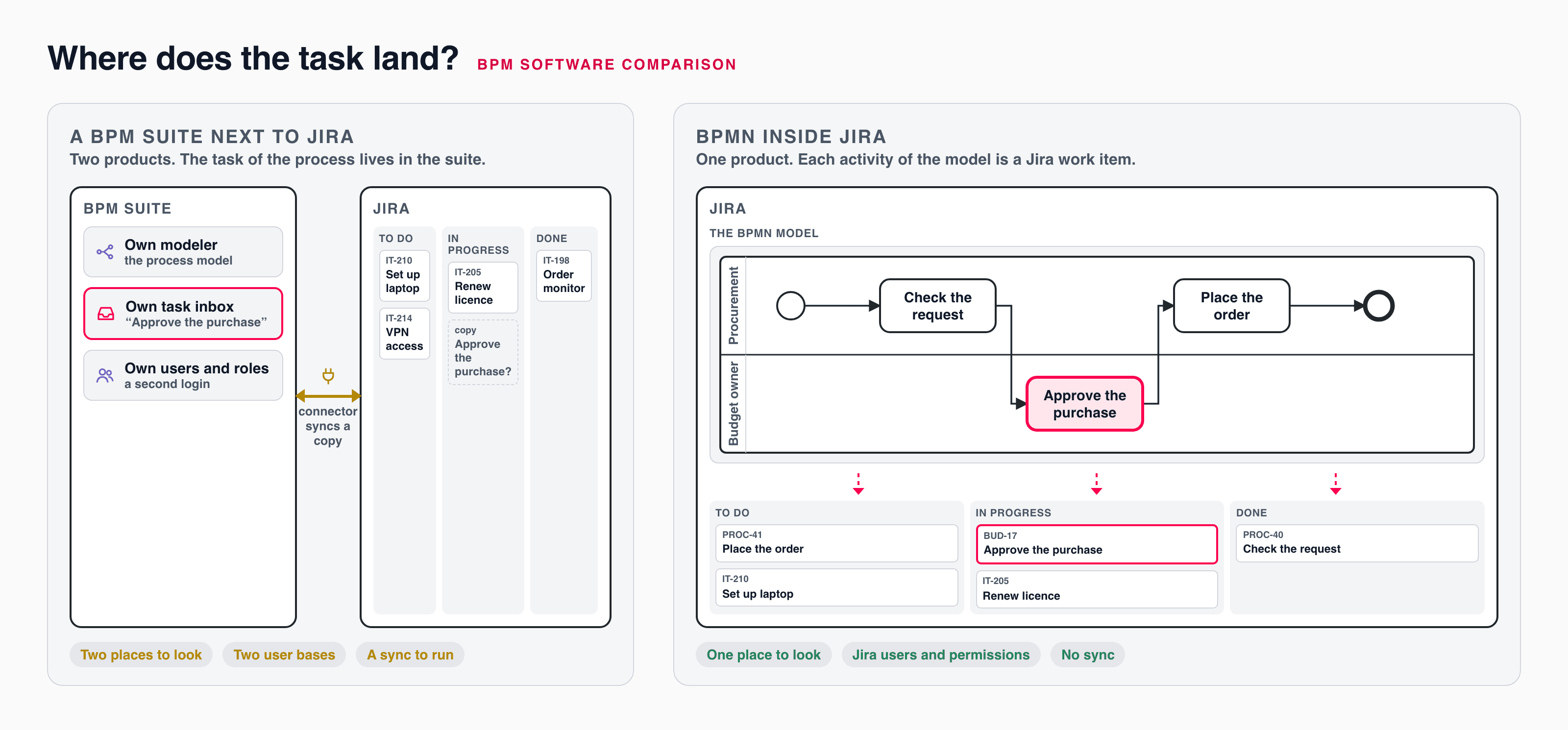
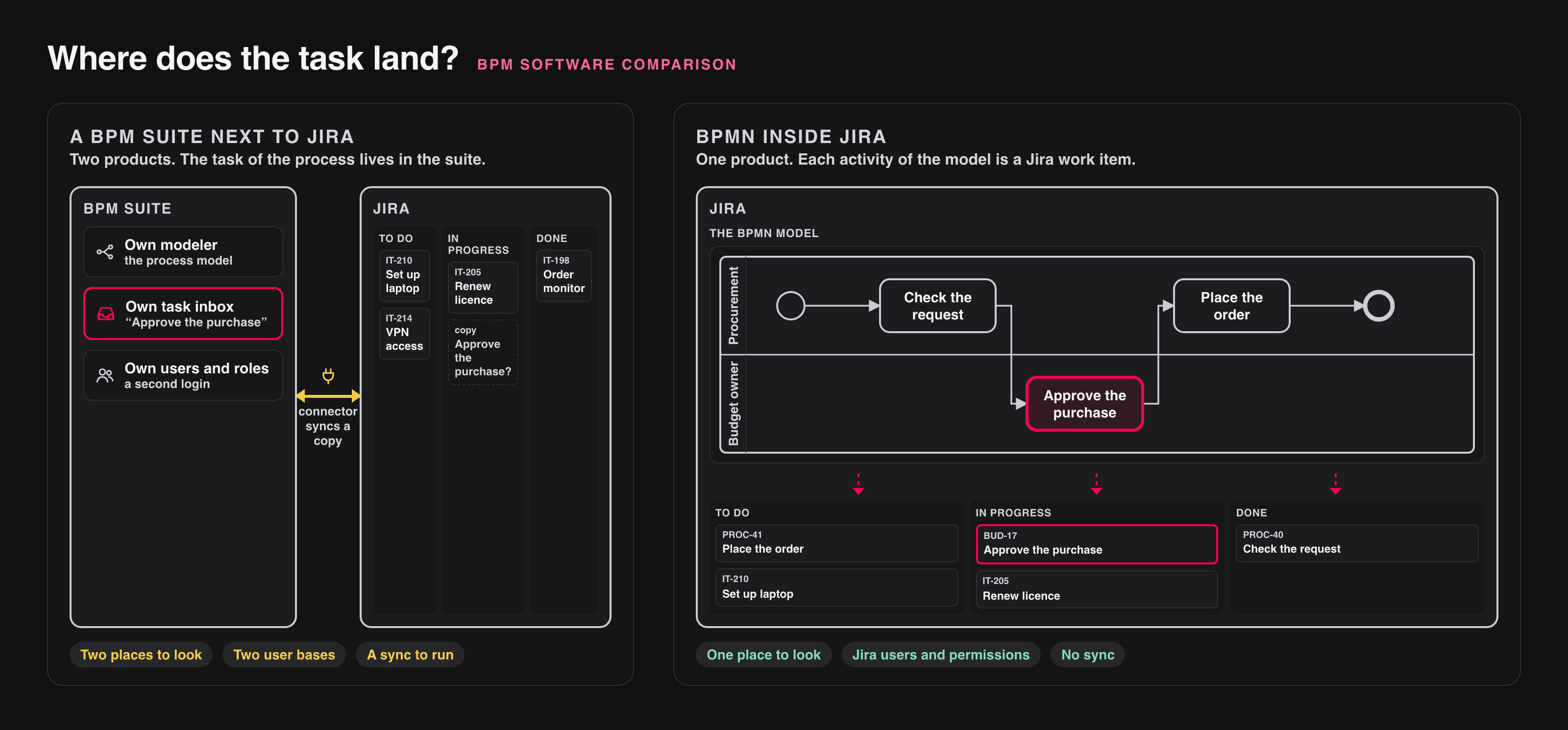
Two architectures: a BPM suite with its own task inbox next to Jira, or a BPMN engine inside Jira, where each activity of the model is a work item.
It is the wrong choice when systems do most of the work, when you need process mining, RPA robots, DMN, or multi-instance activities, or when you need self-managed hosting beyond March 2029. See BPMN Coverage.
Regulated or Self-Managed Operation
If data has to stay on your own infrastructure, thirteen systems can be self-managed: Appian, Bizagi, Bonita, Camunda, Creatio, Flowable, IBM Business Automation Workflow, NewgenONE, Nintex, Pega Platform, ProcessMaker, TIM Flow, and UiPath. Bonita, Flowable, and ProcessMaker have an open-source core. Check which features the self-managed edition lacks and how long it is supported.
The Systems in Detail
The sections are in alphabetical order, and each follows the same structure: what the system is, its strengths, its trade-offs, who it fits, its size and analyst position, and how it relates to Jira. Statements marked “the vendor says” are the vendor’s own claims.
Appian
- What it is: A low-code platform that combines process automation, RPA, process mining (Process HQ), and AI agents (Agent Studio), offered as Appian Cloud or self-managed. [33, 37, 34]
- Strengths: One platform for workflow, robots, mining, and agents. Leader of the 2026 BOAT Magic Quadrant. [39, 4] A free Community Edition exists. The vendor’s “Appian Guarantee” promises a first application in eight weeks for a fixed fee. [40]
- Trade-offs: Processes are Appian process model objects in a BPMN-based notation. BPMN files move in and out through a utility that Appian provides as-is on its AppMarket. [35] Decision tables use DMN hit policies, but the documentation describes no DMN file exchange. [36] The pricing page names tiers per user and application without amounts.
- Best for: Large organizations. Appian says its sales focus is on organizations with more than 2,000 employees, in financial services, government, life sciences, and insurance.
- Size and analysts: Revenue of USD 726.9 million in 2025 and 2,149 employees at year end. [33]
- Relation to Jira: We found no connector built by Appian. The AppMarket lists a Jira plug-in by the partner Vuram. [38] Human tasks appear in Appian’s own task list.
ARIS
- What it is: A suite for process modeling, analysis, mining, and governance. ARIS was part of Software AG and has been a company of its own since 2025. [135, 136, 137]
- Strengths: BPMN 2.0 and DMN modeling, simulation, and process mining for large process landscapes. [139, 140] Trade press names ARIS a Leader for process intelligence at both Gartner and Forrester. [8, 13]
- Trade-offs: We found no process engine: models are implemented in other systems. There are no public prices. [138]
- Best for: Large enterprises that document and govern a whole process architecture.
- Size and analysts: Revenue is not published. Not part of the BOAT report.
- Relation to Jira: None found.
Bizagi
- What it is: A low-code BPM suite. Bizagi Modeler is a free BPMN 2.0 modeler, Bizagi Studio turns models into applications, and users work in the Bizagi Work Portal. [99, 101]
- Strengths: A free modeler with BPMN file exchange, a complete suite from model to running process, and a Jira connector of its own. [102] Bizagi names more than 400 enterprise customers. [98]
- Trade-offs: The platform is priced by consumption and by quote. [100] We found no RPA or process mining of its own, only integrations.
- Best for: Organizations that want business analysts to model in BPMN and IT to automate in the same suite.
- Size and analysts: Founded in 1989, privately held, no published revenue. [98] Included in both BOAT editions.
- Relation to Jira: The connector creates Jira work items from a Bizagi process. Tasks stay in the Work Portal.
Bonita
- What it is: An open-source BPM platform with a studio, a runtime, and a UI designer. Its vendor Bonitasoft renamed itself Ofelia in 2026. [116, 118]
- Strengths: A free open-source edition, BPMN 2.0 execution, self-hosting, and Jira and Confluence connectors of its own. [117, 120]
- Trade-offs: The free edition is limited to 150 process instances per month. [117] A BPMN import converts unsupported elements to the nearest supported one. [119] The company is in the middle of a rebrand.
- Best for: Teams that want to start with an open-source engine and build their own process applications.
- Size and analysts: Founded in 2009, more than 150 customer organizations and about 70 employees, according to the company. Fortino Capital has held a majority since 2022. [116, 121] Not part of the BOAT report.
- Relation to Jira: The Jira connector creates, updates, searches, and transitions work items.
Camunda
- What it is: A process orchestration platform for developers. Its engine executes BPMN 2.0 and DMN directly, as a cloud service or self-managed. [92, 90] As a BPMN engine, it is the closest counterpart to the engine of Flower BPM: both run the BPMN model itself, Camunda for services and systems, Jira & Flower BPM for human tasks.
- Strengths: Standards-based execution at volume, for services, systems, and human tasks. Camunda says it is a Visionary of the 2026 BOAT Magic Quadrant and a Leader of the Forrester Wave for adaptive process orchestration. [97, 14]
- Trade-offs: It is built for engineering teams. Human tasks appear in Camunda Tasklist or in an application you build on the API. [93] Production use of the self-managed edition requires an enterprise license, and there is no price list. [90] The Community Edition of Camunda 7 had its final release in October 2025. [96]
- Best for: Organizations with developers who automate core processes across many systems.
- Size and analysts: Camunda is private. In August 2026 it reported annual recurring revenue close to USD 200 million and more than 700 customers. [88]
- Relation to Jira: We saw no Jira connector in Camunda’s own connector list. The Camunda Marketplace lists one published by Infosys. [94, 95]
Celonis
- What it is: A vendor specialized in process mining. Celonis reads event data from business systems and shows how processes really run. Since 2025 it also offers an Orchestration Engine. [131, 132]
- Strengths: Analysis of real process behavior from system data, which a modeling tool does not provide. Trade press names Celonis a Leader for process intelligence at both Gartner and Forrester. [8, 13] A connector reads Jira Cloud data. [134]
- Trade-offs: Orchestration is a recent addition, and the material we could read does not say whether it uses BPMN. BPMN 2.0 modeling exists in Celonis Process Management. [133] There are no public prices.
- Best for: Large enterprises that want to measure and improve processes in ERP and other core systems.
- Size and analysts: Founded in 2011, privately held, more than 1,000 customers and 3,000 employees, according to the company. [131] Revenue is not published.
- Relation to Jira: Complementary. Celonis can mine the work items that a process in Jira produces.
Creatio
- What it is: A no-code platform for workflows and CRM. Processes are built in its Process Designer, which is based on BPMN and uses its own set of elements. [188]
- Strengths: Workflows, applications, and CRM on one platform, in the cloud or, with the Enterprise and Unlimited plans, on premises. [192, 193] List prices are published: Growth at USD 40 and Enterprise at USD 75 per user per month. [191] AI agents came with the Creatio 10x release in June 2026. [195]
- Trade-offs: A .bpmn file is converted on import. In Creatio’s words, “Boundary events are imported as non-executable elements”, and pools and message flows are not imported. [189] The Unlimited plan is priced on request, and new customers buy at least USD 10,000 per year. [191, 196] We found no RPA and no process mining.
- Best for: Organizations that want to run sales, service, and internal workflows on one no-code platform.
- Size and analysts: Privately held. Creatio raised USD 200 million at a valuation of USD 1.2 billion in June 2024. [194] It publishes no revenue and, on the pages we read, no founding year. Not part of the BOAT report.
- Relation to Jira: A connector by a third party on the Creatio Marketplace imports Jira data. [197] Tasks are assigned to a user, a manager, or a role and stay in Creatio. [190]
Flowable
- What it is: A platform built on engines for the three standards BPMN, CMMN, and DMN, with an open-source core under the Apache 2.0 license and an enterprise product. [112, 111]
- Strengths: Case management with CMMN next to BPMN and DMN, and deployment in the cloud, on premises, or hybrid. Flowable names more than 600 enterprise customers. [111]
- Trade-offs: Enterprise prices are not public. [113] We found no Jira connector, no process mining, and no RPA.
- Best for: Regulated enterprises with their own development teams. Flowable names banking, insurance, healthcare, and the public sector.
- Size and analysts: Flowable AG, Zurich, founded in 2010, privately held. Included in both BOAT editions. [111, 115]
- Relation to Jira: None found. Tasks appear in Flowable Work. [114]
IBM Business Automation Workflow
- What it is: IBM’s BPM product, part of IBM Cloud Pak for Business Automation. IBM positions watsonx Orchestrate next to it for AI agents. [70, 73]
- Strengths: Import and export of BPMN 2.0 are documented, and IBM offers separate products for process mining, RPA, and decisions. [71] Trade press names IBM a Leader of the Forrester Wave for digital process automation of Q3 2025. [12]
- Trade-offs: The engine runs IBM’s own workflow objects. An imported BPMN model is mapped to them, and elements outside the mapping are not imported. [72] IBM publishes no price for the workflow product.
- Best for: Organizations that already run IBM middleware and want workflow, decisions, and robots from one vendor.
- Size and analysts: IBM reported revenue of USD 67.5 billion for 2025 and does not publish product revenue. [69] IBM is included in both BOAT editions.
- Relation to Jira: We found no Jira connector specific to the workflow product. watsonx Orchestrate documents a Jira connection. [74]
Jira & Flower BPM
- What it is: Atlassian’s work management platform with BPMN added. Jira workflows handle the statuses of one work item, Jira Automation runs rules on events, and the Flower app runs a BPMN 2.0 model drawn inside Jira, whose activities become Jira work items. [21]
- Strengths: Human tasks land on the Jira boards teams already use, under Jira’s permissions and data residency. [25] Lanes assign the work items at run time, escalation boundary events hand a decision to a manager while the task stays open, and a process goes live from inside Jira without a developer. [21] A throw event triggers a Jira Automation rule, which can call a Rovo AI agent. [27, 29]
- Trade-offs: It coordinates people more than systems: service, script, send, and business rule tasks run only as steps that a Jira Automation rule does, the script of a model never runs, multi-instance markers, transactions, and compensation are not executed, DMN is not evaluated, and timers run once a day. [22, 23, 24] No process mining, no RPA robot. Rovo agents need a paid plan. [31] Self-managed hosting ends with Jira Data Center in March 2029. [18, 26]
- Best for: Processes of human tasks across teams that already work in Jira, such as onboarding and approvals.
- Size and analysts: Atlassian reported revenue of USD 6,572 million for fiscal year 2026, without figures by product, and is not part of the BOAT report. [15] The Flower app is backed by Atlassian Ventures. [28]
- Relation to Jira: The process runs inside Jira. Jira Standard costs USD 8.48 per user per month, the Flower app USD 2.80, free for up to 10 users. [17, 20]
Kissflow
- What it is: A cloud platform for low-code and no-code apps, forms, workflows, and boards. [127]
- Strengths: Aimed at business users who build and change workflows themselves. Kissflow has a Jira connector of its own and names more than 10,000 customer companies. [130, 127]
- Trade-offs: We found no statement on BPMN or DMN: workflows are built in Kissflow’s own designer. It is cloud only. The pricing page asks for a quote, and a Kissflow article names USD 2,500 per month as the starting price. [128, 129]
- Best for: Departments that replace spreadsheets and e-mail approvals without a process modeling standard.
- Size and analysts: Founded in 2003 as OrangeScape, more than 350 employees, privately held. [127] Not part of the BOAT report.
- Relation to Jira: The connector exchanges data between Kissflow workflows and Jira. Tasks stay in Kissflow.
Microsoft Power Automate
- What it is: The automation product of the Microsoft Power Platform: cloud flows, desktop flows (RPA), and process mining. [55]
- Strengths: Public list prices, from USD 15 per user per month for the Premium plan. [55] Approvals are answered in Outlook and Microsoft Teams, so tasks also land in tools people already use. [59] Microsoft publishes its own Jira connector. [60]
- Trade-offs: In Microsoft’s words, “Power Automate is a public cloud service only”. [56] It is not a BPMN platform: flows are JSON definitions, and BPMN appears only as an export format of process mining. [57, 58] We found no DMN support.
- Best for: Organizations on Microsoft 365 that automate approvals, notifications, and data transfers between applications.
- Size and analysts: Microsoft reported revenue of USD 331,839 million for fiscal year 2026 and does not publish the revenue of Power Automate. [54] Microsoft is included in the 2026 BOAT report.
- Relation to Jira: The Jira connector is a premium connector. A flow can create Jira work items. According to its documentation, the connector does not reach a Jira Server behind a firewall. [60]
NewgenONE
- What it is: The low-code platform of Newgen Software, a listed company from New Delhi. It combines process automation with content services and customer communication, in the cloud or on premises. [156, 155]
- Strengths: Process and document handling in one platform, with RPA and process insights, and the published financial figures of a listed company. [155]
- Trade-offs: BPMN is one of two views of the process designer. [157] We found no public prices and no Jira connector. Newgen was a Niche Player of the 2025 BOAT edition, according to Newgen, and is not in the 2026 list. [158, 1]
- Best for: Banks, insurers, and government organizations with document-heavy processes.
- Size and analysts: Revenue of INR 1,574 crore in the fiscal year to March 2026. [155]
- Relation to Jira: None found.
Nintex
- What it is: A portfolio for workflow automation, forms, RPA, document generation, and e-signature, plus Nintex Process Manager for process documentation. It comes as a cloud service and as the self-hosted Nintex Automation K2. [106, 104]
- Strengths: Broad coverage of document-centric work, a documentation tool that business users can maintain, and a Jira connector. [109]
- Trade-offs: The workflow designer is not BPMN: according to an answer by Nintex staff, a workflow design cannot be exported as BPMN. BPMN import and export exist in Process Manager, for documentation. [107, 108] There is no price list.
- Best for: Departments that automate forms and documents. Nintex also offers a product for Salesforce.
- Size and analysts: Founded in 2006. TPG agreed to buy a majority stake in 2021, and Thoma Bravo kept a minority. [105] Revenue is not published. Included in both BOAT editions.
- Relation to Jira: The connector of Nintex Automation Cloud creates and updates Jira work items.
Pega Platform
- What it is: A low-code platform built around case management: work is modeled as case types with stages and steps, combined with decisioning, RPA, and process mining. It runs as Pega Cloud or in a client-managed cloud. [41, 42]
- Strengths: Case management and decisioning for long-running, complex work. Leader of the 2026 BOAT Magic Quadrant, where the vendor says it is placed highest for ability to execute, and a Leader for process intelligence platforms. [47, 4, 8]
- Trade-offs: The notation is Pega’s own. A Pega support forum answer of August 2025 says there is no supported import of BPMN 2.0 into flow rules, and Pega Blueprint accepts a BPMN file only as input for a generated case life cycle. [44, 45] Decision tables are Pega’s own format. The pricing page shows no amounts. [43]
- Best for: Enterprise-scale businesses and government agencies, as Pega describes its market.
- Size and analysts: Revenue of USD 1,745.8 million in 2025 and 5,598 employees in January 2026. [41]
- Relation to Jira: A Pega Marketplace component links Pega’s development backlog to Jira. We found no general connector for process tasks. [46]
ProcessMaker
- What it is: A low-code BPM platform with a BPMN-based modeler and forms. Its core is open source under the AGPL-3.0 license. ProcessMaker announced its merger with Decisions in November 2025. [123, 122]
- Strengths: An open-source core and process intelligence from the acquisition of Workfellow. [125] The vendor says existing ProcessMaker implementations remain supported and developed.
- Trade-offs: The product now sits inside a merged company. Decision tables are a separate package. [124] There are no public prices.
- Best for: Organizations that want forms and approvals on a BPMN model with an open-source core.
- Size and analysts: No published revenue or customer numbers. Not part of the BOAT report.
- Relation to Jira: None found.
SAP Signavio and SAP Build Process Automation
- What it is: Two products. SAP Signavio models processes in BPMN 2.0 and mines them. Signavio was acquired by SAP in 2021. SAP Build Process Automation executes workflows and RPA on the SAP Business Technology Platform. [77, 78, 84]
- Strengths: BPMN 2.0 and DMN modeling with file exchange, process mining close to SAP applications, and a Leader position for process intelligence platforms for the fourth year in a row, according to SAP. [79, 86]
- Trade-offs: Modeling and execution are separate services. According to an SAP community post, a BPMN model imported into SAP Build Process Automation becomes a process whose forms and approvals still have to be completed. [82] We found no self-managed option.
- Best for: Organizations whose core processes run in SAP applications.
- Size and analysts: SAP reported revenue of EUR 36.80 billion for 2025. [75, 76] SAP is included in both BOAT editions.
- Relation to Jira: SAP Integration Suite, a separate product, has a Jira adapter. [85] Tasks appear in SAP My Inbox. [83]
ServiceNow
- What it is: A workflow platform that grew out of IT service management. Workflow Studio builds flows, subflows, and playbooks, App Engine builds low-code apps, and the platform includes process mining and RPA. [48] Of the systems here, it is the closest in scope to Jira as a platform for work and service management with workflows.
- Strengths: Scale: revenue of USD 13,278 million in 2025 and about 8,700 customers. [49, 48] Leader of the BOAT Magic Quadrant for the second year, according to ServiceNow. [53, 4]
- Trade-offs: We found no BPMN or DMN support in the official documentation. Flows and decision tables use ServiceNow’s own formats. [50] Prices are by quote. Most customers use the cloud service. A self-hosted variant called Private Stack exists, without the features that depend on services hosted by ServiceNow. [51]
- Best for: Enterprises that already run IT, HR, or customer service on ServiceNow.
- Size and analysts: 29,187 employees at the end of 2025. [48]
- Relation to Jira: ServiceNow offers a Jira spoke for its Integration Hub, which needs an Integration Hub subscription. [52] Tasks stay in ServiceNow.
TIM Flow
- What it is: The workflow platform of TIM Solutions GmbH from Garching near Munich, registered in 2002. Older material calls the product TIM BPM Suite. It runs workflows of human tasks with forms, task assignment, and escalations. [141, 145, 142, 152]
- Strengths: It runs BPMN 2.0 models from its own designer or from modeling tools such as ADONIS, whose vendor names TIM its preferred engine for human workflows. [146, 151] It runs as a cloud service, single-tenant, or on premises. [143] Version 26.0 (October 2026) added AI agents as process steps. [148]
- Trade-offs: The documented BPMN set is small: user and script tasks, exclusive and parallel gateways, sub-processes, and error and escalation boundary events. [146] BPMN files are imported into Workflow Design, but the documentation does not say whether the engine runs the BPMN XML itself or a converted definition; the path from SAP Signavio uses a stencil for jPDL. [187, 185] Connectors are REST and file based; no Jira connector, RPA, or process mining found. [147] There is no price list; licenses are issued per installation and users. [149]
- Best for: Organizations that turn existing BPMN models of approval and service processes into workflows.
- Size and analysts: Privately held through a holding company, without published revenue. [145, 153] It names Deutsche Bahn, BMW M, and Munich Airport as customers; a partner page counts more than 500. [144, 150] Not part of the BOAT report.
- Relation to Jira: None documented beyond the REST connector. Tasks appear in its task list and in task e-mails. [154]
UiPath (Maestro)
- What it is: UiPath is known for RPA. Its product Maestro models processes in BPMN 2.0 and runs the model, with robots, agents, and people as participants. [64, 62]
- Strengths: BPMN 2.0 modeling and execution, DMN 1.3 decisions in business rule tasks, cloud and self-hosted deployment, and a free Community plan. [65, 66] Leader of the 2026 BOAT Magic Quadrant. [68, 4]
- Trade-offs: Maestro executes a documented subset of BPMN. Pools and lanes, the loop marker, the complex gateway, and several event types are for modeling only. The DMN task is a preview and comes without a DMN editor. [64, 65]
- Best for: Enterprises whose automation program is built around robots and agents and now needs a process layer.
- Size and analysts: Revenue of USD 1,611 million in fiscal year 2026, annual recurring revenue of USD 1,853 million, and about 10,747 customers. [63, 62]
- Relation to Jira: A Jira connector in UiPath Integration Service, for Jira Cloud only. [67] Human tasks appear in UiPath Action Center.
Frequently Asked Questions
What is BPM software?
BPM software is software to model, run, monitor, and improve business processes. A full suite contains a process modeler, an engine that runs the model, a task list for people, and reporting.
What is the best BPM software in 2026?
There is no single best product. Appian, Pega, ServiceNow, and UiPath are the Leaders of the 2026 Gartner Magic Quadrant for Business Orchestration and Automation Technologies. Camunda and Flowable fit developers who need BPMN and DMN. ARIS, Celonis, and SAP Signavio fit process analysis. Teams that work in Microsoft 365, ServiceNow, or Jira can run processes on the platform they already have.
How do I choose BPM software?
Answer eight questions: what must be automated (people, systems, or both), who builds the processes, where tasks land, whether you want the BPMN standard, where the system runs, what it costs to start, how large the vendor is, and what its AI roadmap is. Then compare the systems that fit on the same facts.
Is there still a Gartner Magic Quadrant for BPM?
Not under that name. Gartner retired the Magic Quadrant for Intelligent Business Process Management Suites. Since October 2025 the market is covered by the Magic Quadrant for Business Orchestration and Automation Technologies.
Which BPM tools execute BPMN 2.0 directly?
In this comparison: Bizagi, Bonita, Camunda, Flowable, Jira & Flower BPM, ProcessMaker, TIM Flow, and UiPath Maestro. None of them executes all of BPMN: against a catalog of 55 elements, their documentation names between 8 and 48. Appian, Pega, ServiceNow, and Power Automate use their own notations, and IBM, SAP Build Process Automation, and Creatio convert a BPMN file into their own format on import.
How many BPMN elements do BPM engines support?
It depends on the engine, and every vendor documents its own subset. Counted against the same 55 elements: Camunda 48, Bonita 35, Flowable 35, Bizagi 32, ProcessMaker 33, UiPath Maestro 30, Jira & Flower BPM 43, and TIM Flow 8. Elements the documentation does not mention are counted as not documented, not as missing. See the element matrix.
What is the difference between RPA and AI agents?
An RPA robot operates the user interface of an application by fixed steps. An AI agent is built on a language model and carries out a task from a prompt. Ten systems in this comparison offer both, eight offer agents without robots.
How much does BPM software cost?
Most vendors quote individually. Published prices in this comparison: Microsoft Power Automate Premium at USD 15 per user per month, UiPath Basic from USD 25 per month, and Jira Standard at USD 8.48 per user per month plus the Flower app at USD 2.80 per user per month for the first 100 users. Bonita, Camunda, Flowable, and ProcessMaker offer free or open-source editions with limits.
Which BPM software integrates with Jira?
Bizagi, Bonita, Kissflow, Microsoft Power Automate, Nintex, ServiceNow, and UiPath publish their own Jira connectors, and Celonis reads Jira data for mining. With these, Jira is a connected system. With Jira and Flower, the process runs in Jira itself.
Is Jira a BPM tool?
Jira alone manages work items and their workflows. With a BPMN app such as Flower, Jira also models and runs business processes in BPMN 2.0. The five-part series Jira as a BPM System covers why, what, and how, from the platform question to a process in daily operation.
Does Jira have RPA or AI agents?
Jira has no RPA robots. Atlassian offers Rovo AI agents in Jira Cloud: an agent can work on a work item, and a Jira Automation rule can call an agent with the action “Use Rovo agent”. In Jira & Flower BPM, a throw event of the BPMN process triggers such a rule. Rovo agents use Rovo credits. [30, 29, 31]
Methodology
- Focus. The comparison looks at BPMN automation of human work and management processes, including AI agents that work together with people. The orchestration of services and machines is outside its focus. The catalog of BPMN elements is the full catalog, not a selection for human work, so that no system is measured on a list chosen for it.
- Selection. We started from the 20 vendors of the 2026 Gartner BOAT Magic Quadrant and kept those that offer process modeling together with execution. We added Bonita, ProcessMaker, Kissflow, and NewgenONE, which buyers often consider, TIM Flow as a vendor from the German-speaking market, Creatio as a no-code platform for workflows and CRM, and Celonis and ARIS as the leading process intelligence products. Integration, RPA-only, and app development vendors of the BOAT list (Amazon Web Services, Automation Anywhere, Boomi, Mendix, n8n, OutSystems, Salesforce, SS&C Blue Prism, Workato) are not included.
- BPMN coverage. The eight engines that run a BPMN 2.0 model were read against one fixed catalog of 55 elements in ten groups: tasks, sub-processes, markers, gateways, start events, intermediate catch events, intermediate throw events, boundary events, end events, and participants. An element counts as executed only if the vendor’s documentation says so; a documented limit makes it partial; an element the vendor lists as converted, removed, or for modeling only counts as not executed; an element the pages do not mention counts as not documented. The catalog was fixed before counting and is the same for every system. The counts state the documentation as of 16 November 2026, not tests of the products.
- Sources. Figures come from annual reports, stock exchange filings, and company press releases. Product facts come from the vendors’ documentation and pricing pages. Analyst positions come from public abstract pages, vendor announcements, and trade press, not from the paid reports.
- What we left out. We publish no revenue estimates for private companies, no quadrant positions that a vendor has not published, and no user ratings, because review sites could not be read consistently.
- Jira & Flower BPM. Facts about Jira come from Atlassian’s pages and filings, facts about the Flower app from its documentation and its Atlassian Marketplace listing. The Flower app is our product, so we are not a neutral party. For that reason the table uses the same columns and the same rules for every system, in alphabetical order, without a ranking and without a highlighted row.
- Date. The comparison describes the state of November 2026. Products, prices, and ownership change. If you find an error, tell us and we correct it.
- Trademarks. All product and company names are trademarks of their owners. Gartner and Magic Quadrant are trademarks of Gartner, Inc. Forrester Wave is a trademark of Forrester Research, Inc. Analyst firms do not endorse the vendors in their reports, and this article is not affiliated with any of them.
Sources
- Gartner: Magic Quadrant for Business Orchestration and Automation Technologies, 14 September 2026 (abstract with the list of 20 vendors). Accessed 15 and 16 November 2026.
- Gartner: Magic Quadrant for Business Orchestration and Automation Technologies, 15 October 2025 (first edition, abstract). Accessed 15 and 16 November 2026.
- Gartner: Critical Capabilities for Business Orchestration and Automation Technologies, 15 September 2026 (abstract). Accessed 15 and 16 November 2026.
- Automation Today: Gartner report reflects convergence of automation and AI orchestration, 21 September 2026. Accessed 15 and 16 November 2026.
- Gartner: Magic Quadrant for AI-Augmented Low-Code Application Platforms, 28 September 2026 (abstract). Accessed 15 and 16 November 2026.
- OutSystems: OutSystems on the 2026 Gartner Magic Quadrant for AI-Augmented Low-Code Application Platforms (earlier name of the report). Accessed 15 and 16 November 2026.
- Gartner: Magic Quadrant for Process Intelligence Platforms, 5 May 2026 (abstract). Accessed 15 and 16 November 2026.
- Automation Today: Gartner names 2026 process intelligence leaders, 11 May 2026. Accessed 15 and 16 November 2026.
- Gartner: Magic Quadrant for Robotic Process Automation, 24 June 2026 (abstract). Accessed 15 and 16 November 2026.
- Gartner: Market Guide for Business Process Automation Tools, 13 July 2026 (abstract). Accessed 15 and 16 November 2026.
- Appian: Press release on the 2019 Gartner Magic Quadrant for Intelligent Business Process Management Suites (report dated 30 January 2019). Accessed 15 and 16 November 2026.
- Automation Today: Forrester names Appian, IBM, Pegasystems, Salesforce and ServiceNow as DPA leaders (The Forrester Wave: Digital Process Automation Software, Q3 2025). Accessed 15 and 16 November 2026.
- PEX Network: Forrester analyzes 15 process intelligence vendors in new Wave report (Q3 2025). Accessed 15 and 16 November 2026.
- Camunda: Press release: Camunda named a Leader in The Forrester Wave: Adaptive Process Orchestration Software, Q3 2026. Accessed 15 and 16 November 2026.
- Atlassian: Fourth quarter and fiscal year 2026 results (exhibit 99.1 to Form 8-K, fiscal year ended 30 June 2026). Accessed 15 and 16 November 2026.
- Atlassian: Prospectus (Form 424B4), December 2015: company history since 2002. Accessed 15 and 16 November 2026.
- Atlassian: Jira pricing: Free, Standard, Premium, Enterprise (US dollar prices with monthly billing). Accessed 15 and 16 November 2026.
- Atlassian: Data Center end of life. Accessed 15 and 16 November 2026.
- Atlassian: Atlassian on the 2026 Gartner Magic Quadrant for IT Service Management Platforms (report dated 27 July 2026). Accessed 15 and 16 November 2026.
- Atlassian Marketplace: Flower Business Process & Workflow Automation BPMN for Jira: listing, trust signals and pricing (read through the public Marketplace REST API). Accessed 15 and 16 November 2026.
- Flower: BPMN Coverage in Jira. Accessed 15 and 16 November 2026.
- Flower: Limits and Host Differences (Forge, Connect, Data Center). Accessed 15 and 16 November 2026.
- Flower: Known Issues. Accessed 15 and 16 November 2026.
- Flower: DMN (Deprecated). Accessed 15 and 16 November 2026.
- Flower: Data Residency. Accessed 15 and 16 November 2026.
- Flower: Flower FAQ (platforms, licensing, permissions, reporting). Accessed 15 and 16 November 2026.
- Flower: Triggering Jira Automation with BPMN events. Accessed 15 and 16 November 2026.
- Flower: Flower website (backed by Atlassian Ventures). Accessed 15 and 16 November 2026.
- Atlassian: Automation smart values: Rovo agents (the action "Use Rovo agent" in an automation rule). Accessed 15 and 16 November 2026.
- Atlassian: Collaborate on work items with AI agents (Rovo agents on work items, workflow transitions and board columns). Accessed 15 and 16 November 2026.
- Atlassian: How Rovo credits work (allowances per plan, credits per agent call). Accessed 15 and 16 November 2026.
- Atlassian Marketplace: Business Process Manager: Productive Workflow Automation (SaaSJet Studios): listing and pricing. Accessed 15 and 16 November 2026.
- Appian: Annual report (Form 10-K) for the year ended 31 December 2025. Accessed 15 and 16 November 2026.
- Appian: Appian Platform pricing and deployment options. Accessed 15 and 16 November 2026.
- Appian: AppMarket: BPMN Transformer (utility, provided as-is). Accessed 15 and 16 November 2026.
- Appian: Documentation: Create a Decision. Accessed 15 and 16 November 2026.
- Appian: Appian 26.10 release notes (Process HQ, RPA, Agent Studio). Accessed 15 and 16 November 2026.
- Appian: AppMarket: JIRA Connected System (plug-in by Vuram). Accessed 15 and 16 November 2026.
- Appian: Appian on the 2026 Gartner Magic Quadrant for BOAT. Accessed 15 and 16 November 2026.
- Appian: The Appian Guarantee. Accessed 15 and 16 November 2026.
- Pegasystems: Annual report (Form 10-K) for the year ended 31 December 2025. Accessed 15 and 16 November 2026.
- Pegasystems: Pega Platform capabilities. Accessed 15 and 16 November 2026.
- Pegasystems: Pega Platform pricing. Accessed 15 and 16 November 2026.
- Pegasystems: Pega support forum: How to import BPMN 2.0 into Pega (August 2025). Accessed 15 and 16 November 2026.
- Pegasystems: Pega support: Blueprint generates case life cycles from BPMN. Accessed 15 and 16 November 2026.
- Pegasystems: Pega Marketplace: Agile Workbench Integration with Jira. Accessed 15 and 16 November 2026.
- Pegasystems: Press release on the 2026 Gartner Magic Quadrant for BOAT (as republished by TechIntelPro). Accessed 15 and 16 November 2026.
- ServiceNow: Annual report (Form 10-K) for the year ended 31 December 2025. Accessed 15 and 16 November 2026.
- ServiceNow: Fourth quarter and full-year 2025 financial results. Accessed 15 and 16 November 2026.
- ServiceNow: Documentation: Decision Builder in Workflow Studio. Accessed 15 and 16 November 2026.
- ServiceNow: Community post: Private Stack (30 April 2026). Accessed 15 and 16 November 2026.
- ServiceNow: Documentation: Jira spoke (Integration Hub). Accessed 15 and 16 November 2026.
- ServiceNow: ServiceNow on the 2026 Gartner Magic Quadrant and Critical Capabilities for BOAT. Accessed 15 and 16 November 2026.
- Microsoft: Annual report (Form 10-K) for the fiscal year ended 30 June 2026. Accessed 15 and 16 November 2026.
- Microsoft: Power Automate pricing (US page). Accessed 15 and 16 November 2026.
- Microsoft: Power Automate: frequently asked questions. Accessed 15 and 16 November 2026.
- Microsoft: Power Automate: manage flows with code (flow definitions). Accessed 15 and 16 November 2026.
- Microsoft: Power Automate Process Mining: process map (BPMN export). Accessed 15 and 16 November 2026.
- Microsoft: Power Automate: get started with approvals. Accessed 15 and 16 November 2026.
- Microsoft: Connector reference: Jira. Accessed 15 and 16 November 2026.
- Microsoft: Microsoft Copilot Studio blog: computer-using agents and agent flows. Accessed 15 and 16 November 2026.
- UiPath: Annual report (Form 10-K) for the fiscal year ended 31 January 2026. Accessed 15 and 16 November 2026.
- UiPath: Fourth quarter and fiscal year 2026 results (exhibit 99.1 to Form 8-K). Accessed 15 and 16 November 2026.
- UiPath: Maestro user guide: BPMN support. Accessed 15 and 16 November 2026.
- UiPath: Maestro user guide: business rules (DMN). Accessed 15 and 16 November 2026.
- UiPath: UiPath pricing. Accessed 15 and 16 November 2026.
- UiPath: Integration Service: Atlassian Jira connector. Accessed 15 and 16 November 2026.
- UiPath: UiPath on the 2026 Gartner Magic Quadrant for BOAT. Accessed 15 and 16 November 2026.
- IBM: Fourth quarter and full-year 2025 results, 28 January 2026. Accessed 15 and 16 November 2026.
- IBM: IBM Business Automation Workflow product page. Accessed 15 and 16 November 2026.
- IBM: Documentation: importing and exporting BPMN 2.0 models. Accessed 15 and 16 November 2026.
- IBM: Documentation: mapping of BPMN 2.0 constructs to workflow objects after import. Accessed 15 and 16 November 2026.
- IBM: watsonx Orchestrate pricing. Accessed 15 and 16 November 2026.
- IBM: watsonx Orchestrate documentation: Jira connection. Accessed 15 and 16 November 2026.
- SAP: SAP announces Q4 and full-year 2025 results. Accessed 15 and 16 November 2026.
- SAP: Quarterly statement Q4 2025. Accessed 15 and 16 November 2026.
- SAP Signavio: SAP completes the acquisition of Signavio, 5 March 2021. Accessed 15 and 16 November 2026.
- SAP: SAP Signavio Process Manager: import BPMN 2.0 XML. Accessed 15 and 16 November 2026.
- SAP: SAP Signavio Process Manager: DMN decision logic. Accessed 15 and 16 November 2026.
- SAP: SAP Build Process Automation documentation: import a BPMN process (elements are mapped to process elements, unsupported ones become placeholders). Accessed 15 and 16 November 2026.
- SAP: SAP Build Process Automation documentation: activity mappings for BPMN models (laneSet is not transformed). Accessed 15 and 16 November 2026.
- SAP: SAP community post: import BPMN and generate an executable process with SAP Build Process Automation. Accessed 15 and 16 November 2026.
- SAP: SAP Build Process Automation: using My Inbox. Accessed 15 and 16 November 2026.
- SAP: SAP Build Process Automation pricing. Accessed 15 and 16 November 2026.
- SAP: SAP Integration Suite: Jira receiver adapter. Accessed 15 and 16 November 2026.
- SAP: SAP Signavio in the 2026 Gartner Magic Quadrant for Process Intelligence Platforms. Accessed 15 and 16 November 2026.
- SAP: New Joule Studio: agent development, May 2026. Accessed 15 and 16 November 2026.
- Camunda: Press release: Camunda closing in on $200M in ARR, 4 August 2026. Accessed 15 and 16 November 2026.
- Camunda: About Camunda. Accessed 15 and 16 November 2026.
- Camunda: Camunda pricing and licensing. Accessed 15 and 16 November 2026.
- Camunda: Documentation: BPMN coverage. Accessed 15 and 16 November 2026.
- Camunda: Documentation: What is Camunda 8?. Accessed 15 and 16 November 2026.
- Camunda: Documentation: Tasklist. Accessed 15 and 16 November 2026.
- Camunda: Documentation: out-of-the-box connectors. Accessed 15 and 16 November 2026.
- Camunda Marketplace: Jira Connector (published by Infosys). Accessed 15 and 16 November 2026.
- Camunda: Camunda 7 Enterprise end-of-life extension. Accessed 15 and 16 November 2026.
- Camunda: Camunda on the 2026 Gartner Magic Quadrant for BOAT. Accessed 15 and 16 November 2026.
- Bizagi: About Bizagi. Accessed 15 and 16 November 2026.
- Bizagi: Documentation: supported standards (BPMN 2.0, XPDL). Accessed 15 and 16 November 2026.
- Bizagi: Bizagi platform pricing. Accessed 15 and 16 November 2026.
- Bizagi: Documentation: Bizagi Work Portal. Accessed 15 and 16 November 2026.
- Bizagi: Connectors Xchange: Jira connector. Accessed 15 and 16 November 2026.
- Bizagi: Bizagi AI Agents. Accessed 15 and 16 November 2026.
- Nintex: About Nintex. Accessed 15 and 16 November 2026.
- Thoma Bravo: Press release: TPG agrees to make majority investment in Nintex, 5 October 2021. Accessed 15 and 16 November 2026.
- Nintex: Nintex pricing. Accessed 15 and 16 November 2026.
- Nintex: Nintex community: Is Nintex compatible with BPMN 2.0? (answer by Nintex staff, May 2020). Accessed 15 and 16 November 2026.
- Nintex: Nintex Process Manager: import and export of process models (BPMN 2.0). Accessed 15 and 16 November 2026.
- Nintex: Nintex Automation Cloud: Jira connector. Accessed 15 and 16 November 2026.
- Nintex: Nintex news (Agent Designer and Orchestration, March 2026). Accessed 15 and 16 November 2026.
- Flowable: Company and product information page. Accessed 15 and 16 November 2026.
- Flowable: Flowable open source. Accessed 15 and 16 November 2026.
- Flowable: Flowable pricing. Accessed 15 and 16 November 2026.
- Flowable: Documentation: Flowable Work. Accessed 15 and 16 November 2026.
- Flowable: Flowable on the 2026 Gartner Magic Quadrant for BOAT. Accessed 15 and 16 November 2026.
- Ofelia: About Ofelia (formerly Bonitasoft). Accessed 15 and 16 November 2026.
- Ofelia: Bonita editions and pricing. Accessed 15 and 16 November 2026.
- Ofelia: Bonita downloads. Accessed 15 and 16 November 2026.
- Ofelia: Bonita documentation: import and export a process (BPMN 2.0). Accessed 15 and 16 November 2026.
- Ofelia: Bonita documentation: Jira connector. Accessed 15 and 16 November 2026.
- Jones Day: Fortino Capital Partners acquires majority stake in Bonitasoft, March 2022. Accessed 15 and 16 November 2026.
- Decisions: ProcessMaker and Decisions join forces, 10 November 2025. Accessed 15 and 16 November 2026.
- ProcessMaker: ProcessMaker 4 core on GitHub (AGPL-3.0). Accessed 15 and 16 November 2026.
- ProcessMaker: Documentation: decision tables. Accessed 15 and 16 November 2026.
- Decisions: ProcessMaker acquires Workfellow (process intelligence). Accessed 15 and 16 November 2026.
- Decisions: Decisions platform page (AI agents). Accessed 15 and 16 November 2026.
- Kissflow: About Kissflow. Accessed 15 and 16 November 2026.
- Kissflow: Kissflow pricing. Accessed 15 and 16 November 2026.
- Kissflow: No-code platform pricing comparison 2026 (Kissflow article). Accessed 15 and 16 November 2026.
- Kissflow: Kissflow integrations: Jira. Accessed 15 and 16 November 2026.
- Celonis: About Celonis. Accessed 15 and 16 November 2026.
- Celonis: How AI and process orchestration bring us closer to the autonomous enterprise (Orchestration Engine). Accessed 15 and 16 November 2026.
- Celonis: Documentation: process modeling (BPMN 2.0). Accessed 15 and 16 November 2026.
- Celonis: Documentation: connecting to Jira Cloud (extractor). Accessed 15 and 16 November 2026.
- ARIS: About ARIS. Accessed 15 and 16 November 2026.
- Software AG: Statement on ARIS as a standalone business, 7 January 2025. Accessed 15 and 16 November 2026.
- ARIS: ARIS announces new CEO, 7 January 2026. Accessed 15 and 16 November 2026.
- ARIS: ARIS pricing. Accessed 15 and 16 November 2026.
- Software AG: Manual: Modeling BPMN 2.0 in ARIS. Accessed 15 and 16 November 2026.
- ARIS Community: ARIS participates in the OMG live interoperability demo (BPMN and DMN support), December 2018. Accessed 15 and 16 November 2026.
- TIM Solutions: TIM Flow product page (BPMN 2.0, customers). Accessed 15 and 16 November 2026.
- TIM Solutions: TIM Flow: automate (forms, task assignment, substitutes, escalations). Accessed 15 and 16 November 2026.
- TIM Solutions: TIM Trusted AI (AI models, operating models: multi-tenant SaaS, single-tenant, on-premise). Accessed 15 and 16 November 2026.
- TIM Solutions: Customer success stories. Accessed 15 and 16 November 2026.
- North Data: TIM Solutions GmbH, Garching: commercial register data (Amtsgericht München HRB 140888; registered in January 2002 as SOPware GmbH, later loom GmbH). Accessed 15 and 16 November 2026.
- TIM Solutions: TIM Flow documentation: Modeling Workflows (the BPMN 2.0 symbols TIM Flow executes). Accessed 15 and 16 November 2026.
- TIM Solutions: TIM Flow documentation: Connectors (REST and file connectors). Accessed 15 and 16 November 2026.
- TIM Solutions: TIM Flow documentation: Release Notes (version 26.0 of 30 October 2026: AI agents in the process engine). Accessed 15 and 16 November 2026.
- TIM Solutions: TIM Flow documentation: License management (licence installed on the server, extended for more users). Accessed 15 and 16 November 2026.
- ARIS Community: Partner page of TIM Solutions GmbH (customers, ARIS models as workflows). Accessed 15 and 16 November 2026.
- BOC Group: ADONIS documentation: Process Automation (deploying processes from ADONIS to TIM). Accessed 15 and 16 November 2026.
- BOC Group: Press release: partnership of BOC Group and TIM Solutions (TIM BPM Suite), January 2020. Accessed 15 and 16 November 2026.
- TIM Solutions: About TIM Solutions (management, locations). Accessed 15 and 16 November 2026.
- TIM Solutions: TIM Flow product guide (designer, forms, task mails, AI agents). Accessed 15 and 16 November 2026.
- Newgen Software: Press release: FY2026 results (year ended 31 March 2026), 4 May 2026, as syndicated by Banking Dive. Accessed 15 and 16 November 2026.
- Newgen Software: About Newgen. Accessed 15 and 16 November 2026.
- Newgen Software: NewgenONE process modeling. Accessed 15 and 16 November 2026.
- Newgen Software: Press release on the 2025 Gartner Magic Quadrant for BOAT. Accessed 15 and 16 November 2026.
- Camunda: Documentation: user tasks (assignee, candidate users and groups, due date). Accessed 15 and 16 November 2026.
- Camunda: Documentation: get started with human task orchestration. Accessed 15 and 16 November 2026.
- Flowable: Open-source documentation: BPMN 2.0 constructs. Accessed 15 and 16 November 2026.
- Flowable: Flowable Platform documentation: process editor (one executable process per model, message flows). Accessed 15 and 16 November 2026.
- Flowable: Flowable Platform documentation: BPMN reference, lane. Accessed 15 and 16 November 2026.
- Flowable: Flowable open source 7.0.0 release (no UI applications), 21 September 2023. Accessed 15 and 16 November 2026.
- Ofelia: Bonita documentation: tasks. Accessed 15 and 16 November 2026.
- Ofelia: Bonita documentation: events. Accessed 15 and 16 November 2026.
- Ofelia: Bonita documentation: gateways. Accessed 15 and 16 November 2026.
- Ofelia: Bonita documentation: pools and lanes (the actor of a lane). Accessed 15 and 16 November 2026.
- Ofelia: Bonita documentation: actors (the actor of the lane, or an actor for the step). Accessed 15 and 16 November 2026.
- Ofelia: Bonita documentation: iteration (loop and multi-instantiation). Accessed 15 and 16 November 2026.
- Ofelia: Bonita Process Designer: supported BPMN elements (what Bonita Studio converts or does not receive). Accessed 15 and 16 November 2026.
- Ofelia: Bonita documentation: forms development. Accessed 15 and 16 November 2026.
- ProcessMaker: Documentation: process modeling object descriptions. Accessed 15 and 16 November 2026.
- ProcessMaker: Documentation: Form Task (assignment, due time, loop and multi-instance). Accessed 15 and 16 November 2026.
- ProcessMaker: Documentation: pool and lane objects. Accessed 15 and 16 November 2026.
- ProcessMaker: Documentation: publish your process model. Accessed 15 and 16 November 2026.
- Bizagi: Bizagi Studio documentation: modeling for execution (the BPMN shapes Studio executes). Accessed 15 and 16 November 2026.
- Bizagi: Bizagi documentation: guidance for automation (how shapes of Bizagi Modeler are converted for Studio). Accessed 15 and 16 November 2026.
- Bizagi: Bizagi Studio documentation: performers (work allocation per activity). Accessed 15 and 16 November 2026.
- Bizagi: Bizagi Studio documentation: define forms. Accessed 15 and 16 November 2026.
- Bizagi: Bizagi documentation: Live Processes. Accessed 15 and 16 November 2026.
- UiPath: Maestro user guide: participants (pools and lanes). Accessed 15 and 16 November 2026.
- UiPath: Maestro user guide: user task. Accessed 15 and 16 November 2026.
- UiPath: Maestro user guide: markers (multi-instance). Accessed 15 and 16 November 2026.
- TIM Solutions: TIM Flow documentation: Signavio (swimlanes are assigned to a user or a group). Accessed 15 and 16 November 2026.
- TIM Solutions: TIM Flow documentation: escalation guide. Accessed 15 and 16 November 2026.
- TIM Solutions: TIM Flow documentation: Workflow Design (import of a BPMN model, forms). Accessed 15 and 16 November 2026.
- Creatio: Creatio Academy: Process elements reference (user actions, events, gateways, sub-processes). Accessed 15 and 16 November 2026.
- Creatio: Creatio Academy: Import process (.bpmn files are converted; boundary events are imported as non-executable elements). Accessed 15 and 16 November 2026.
- Creatio: Creatio Academy: Perform task (who performs the task, planned duration, reminder). Accessed 15 and 16 November 2026.
- Creatio: Creatio pricing (Growth, Enterprise, Unlimited; minimum purchase for new customers). Accessed 15 and 16 November 2026.
- Creatio: Compare platform plans (cloud and on-premise per plan). Accessed 15 and 16 November 2026.
- Creatio: Creatio Academy: General Creatio deployment procedure (customer-managed cloud and on-site deployment). Accessed 15 and 16 November 2026.
- Creatio: Press release: USD 200 million raised at a USD 1.2 billion valuation, 26 June 2024. Accessed 15 and 16 November 2026.
- Creatio: Press release: Creatio 10x release (AI Studio, AI agents), 4 June 2026. Accessed 15 and 16 November 2026.
- Creatio: Press release: new pricing from 1 May 2026, 4 May 2026. Accessed 15 and 16 November 2026.
- Creatio Marketplace: Banza Jira connector for Creatio (third party, imports Jira data). Accessed 15 and 16 November 2026.
About Jira & Flower BPM
Jira & Flower BPM is Jira with the app Flower BPM, listed in the Atlassian Marketplace as Flower – Business Process & Workflow Automation (BPMN) for Jira, for Jira Cloud and Jira Data Center. You model business processes in BPMN 2.0 and run them in Jira: for every activity of a process, a Jira work item is created, assigned through swimlanes, shown with its status in the process diagram, and the process continues when the work item is resolved. All process data stays in Jira, so your permissions, boards, and reports keep working.
Start a free 30-day trial on the Atlassian Marketplace or follow the Get Started guide.